What You Are Actually Holding
CCMA Form 7.11 is the Referral of a Dispute form. Your employee or former employee submitted it to open a formal dispute. The CCMA received 140,410 referrals in the 2024/25 financial year. The most common grounds you will see:
Unfair dismissal (Section 185, LRA)
The employee claims the dismissal was not for a fair reason, or the process was procedurally unfair, or both. This is by far the most common referral type.
Unfair labour practice
A claim related to promotion, demotion, suspension, or a benefit the employee believes was unfairly withheld.
Constructive dismissal
The employee resigned and claims the working conditions made continued employment intolerable, effectively arguing they were forced out.
Form 7.11 also contains a section where the employee describes the dispute in their own words and states the relief they are seeking. Read this section carefully. It tells you whether the employee is seeking reinstatement, compensation, or both. Reinstatement - being ordered to take the employee back into employment - is the primary remedy under Section 193 of the LRA and is awarded unless reinstatement is not reasonably practicable, the dismissal was not related to conduct or capacity, or the employee does not wish to be reinstated. Understanding what relief the employee is asking for early shapes your settlement and defense strategy.
Read the form carefully and note two things immediately: the date the employee states as the date of dismissal, and the date stamp on the form itself. These two dates determine whether the referral is within the legal time limit.
First Check: Is the Referral Within the 30-Day Prescription Window?
Section 191(1)(b) of the Labour Relations Act requires an employee to refer an unfair dismissal dispute within 30 days of the date of dismissal. Count from the dismissal date on your termination letter to the CCMA date stamp on the form.
If the referral is outside 30 days
You have a prescription defense - but you must raise it at conciliation. The CCMA does not raise it automatically. The CCMA has discretion to condone a late referral if the employee gives a satisfactory explanation, but materially late referrals with weak explanations are regularly upheld as prescribed.
Important exception
Automatically unfair dismissal disputes (dismissals related to pregnancy, union membership, whistleblowing, or discrimination) have a 90-day referral window, not 30 days. If the employee is alleging that category of dismissal, the standard 30-day count does not apply.
The CCMA Process: A Timeline You Can Plan Against
Understanding the full process removes the anxiety. Nothing in this timeline requires you to act immediately in a way you cannot control. What it does require is that you show up prepared.
The CCMA process is a two-stage system. Conciliation comes first - it is a structured negotiation where the commissioner helps both parties reach a settlement. No ruling is made at conciliation. If no settlement is reached, the commissioner issues a certificate of non-resolution and the matter proceeds to arbitration. Arbitration is a quasi-judicial hearing where evidence is led, witnesses are examined, and the commissioner issues a binding award. These are different settings requiring different preparation. Treating conciliation like arbitration (bringing lawyers without consent, presenting formal evidence bundles, refusing to engage in negotiation) is counterproductive and signals to the commissioner that you are not acting in good faith.
| Stage | Timeframe |
|---|---|
| Form 7.11 filed by employee | Day 0 |
| CCMA contacts employer to schedule conciliation | 5 to 15 working days after referral |
| Conciliation hearing (77% settle here) | Within 30 days of referral |
| Certificate of Outcome (Form 7.12) issued if no settlement | Same day as conciliation |
| Employee requests arbitration (if no settlement) | Within 90 days of certificate |
| Arbitration hearing - binding award issued | 30 to 90 days after arbitration request |
The conciliation is not a trial. It is a facilitated negotiation. You are not under oath. You are not required to agree to anything. The commissioner's role at conciliation is to help both parties reach a settlement - not to make a ruling. If no settlement is reached, the commissioner issues a certificate of non-resolution and the matter moves to arbitration.
The 7-Day Action Checklist
Most employers spend the first week doing nothing because they do not know what to do. The correct response is to spend the week preparing - not waiting.
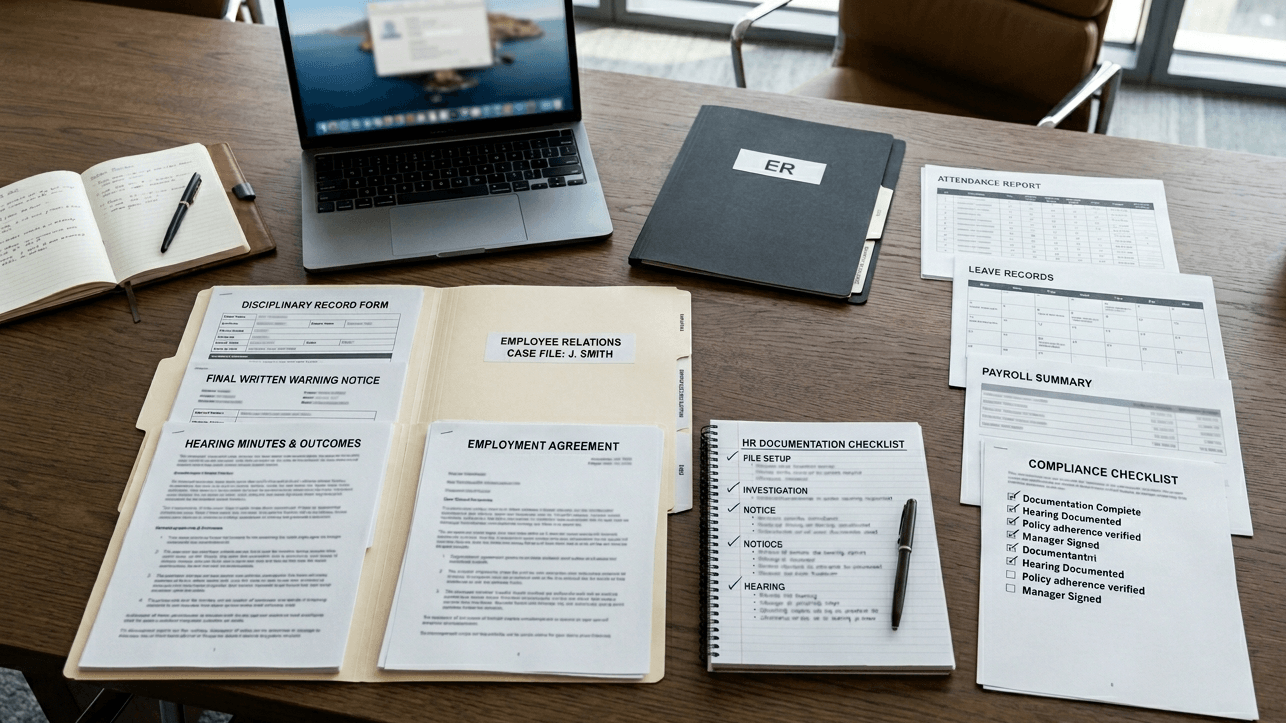
The employers who walk into conciliation in a strong position are the ones who built the documentation trail before the dismissal happened.
Confirm the referral and check prescription
Read the form. Note the date of dismissal the employee states. Calculate whether it falls within 30 days of your termination date. Create a case folder - physical or digital - and label it with the employee's name.
Gather every relevant document
Pull the employment contract, all written warnings, the hearing notice, the hearing record, the outcome letter, the right-to-appeal record, and the final payslip. If anything is missing, note the gap and assess how it affects your position.
Assess your case honestly
The CCMA tests two things: substantive fairness (was there a valid reason?) and procedural fairness (was the correct process followed?). If the hearing had no written record, or the employee was not given written notice of the charges, you have procedural exposure. Identify this before, not during, the conciliation.
Decide on settlement versus defense
Settlement is not an admission of guilt. It is a commercial decision. If your documentation is weak, a negotiated settlement will almost always cost less than losing at arbitration. Maximum arbitration award: 12 months' salary. Legal fees to defend: R15,000 to R40,000. Know your exposure before you choose a position.
Understand who can represent you at conciliation
Legal practitioners are generally not permitted at conciliation without mutual consent (CCMA Rules 25 and 31). A director, fellow employee, or HR practitioner as a company representative may appear. Attempting to bring an attorney without the employee's consent results in exclusion at the start of the hearing.
Prepare your opening statement
At conciliation, the commissioner asks both parties to state their position. Prepare a concise, factual account: date of employment, date of dismissal, reason, process followed. Two minutes maximum. Commissioners hear hundreds of matters annually. A documented, calm position is more persuasive than an emphatic one.
The clock started when it was served
The day-by-day plan above plus the document checklist, as an editable Word document and print-ready PDF. It goes to your inbox, so you still have it the next time this comes up.
The Documents That Win or Lose the Case
A commissioner seeing a complete, chronological file reads the situation very differently from one hearing an employer say "we had a meeting but I didn't write anything down." Documents are not the whole case. But their absence is often the whole loss.
The LRA requires both substantive and procedural fairness. Substantive fairness asks: was there a valid reason for dismissal? Procedural fairness asks: was the correct process followed? An employer who had a valid reason but followed no process faces a procedurally unfair finding. An employer who followed perfect process but had no valid reason faces a substantively unfair finding. Both types of finding can result in compensation awards up to 12 months' salary or reinstatement. Each document in the table below directly supports one or both elements of your defense.
| Document | What It Shows |
|---|---|
| Signed employment contract | The agreed terms including notice period and disciplinary procedure |
| Signed written warnings | Progressive discipline was followed |
| Written notice to attend hearing (dated, delivered) | Employee was informed with at least 48 hours to prepare |
| Hearing record or written minutes | A fair hearing was conducted and documented |
| Written outcome letter with reasons | The decision was communicated correctly per LRA requirements |
| Evidence that the right to appeal was offered | The LRA procedural requirement was met |
| Final payslip confirming leave payout and notice pay | Statutory financial obligations were fulfilled |
Bring physical copies to conciliation. Organise them chronologically. Have a copy for the commissioner and a copy for yourself.
Who Can Represent You at Conciliation
This is what surprises most employers. Under CCMA Rules 25 and 31, legal practitioners (attorneys and advocates) are generally not permitted at conciliation unless both parties consent or the dispute falls into a limited category where legal representation is allowed.
Permitted at conciliation
- A director or owner of the business
- A fellow employee
- An HR practitioner as a company representative
- A trade union official (where applicable)
Not permitted without consent
- Attorneys
- Advocates
- External legal practitioners
Attempting to bring an attorney without the employee's consent results in exclusion at the start of the hearing - and undermines your credibility immediately.
At arbitration, the rules change. Legal representation is permitted, and legal practitioners regularly appear in CCMA arbitration hearings.
Settlement vs Defense: How to Decide
Settlement at conciliation is not an admission of guilt. It is a commercial decision based on the cost and risk of defending through arbitration versus the cost of resolving the matter now. The CCMA's 2024/25 Annual Report recorded 77% of matters settling at the conciliation stage.
If you settle, ensure the agreement states explicitly that it is in full and final settlement of all claims related to the employment relationship and its termination. An agreement silent on scope can leave the door open to related claims in other forums.
Settle when:
- Documentation has significant gaps
- The hearing had no written record
- The employee did not receive written notice of charges
- No right-to-appeal was communicated
- The cost of arbitration exceeds the settlement range
Defend when:
- Full documentation file exists
- Process was followed correctly at every step
- Substantive reason for dismissal is clear and evidenced
- The referral is outside the 30-day prescription window
How to Assess Your Compensation Exposure
Before deciding whether to settle, calculate your realistic maximum exposure at arbitration. Section 194 of the LRA caps compensation for ordinary unfair dismissal at 12 months' remuneration. For automatically unfair dismissal (dismissals related to pregnancy, union membership, or discrimination), the cap is 24 months. Compensation is in addition to any outstanding amounts owed - severance, notice pay, or leave payout not yet paid.
Commissioners have wide discretion on quantum within the cap. A commissioner who sees a complete documentation file, a valid reason for dismissal, and evidence of genuine process may award zero or nominal compensation even if a technical procedural gap exists. A commissioner who sees no written hearing notice, no hearing record, and no reason for termination given to the employee may award the full 12 months. The strength of your documentation is the primary driver of where in the range the award lands.
For a R30,000/month employee: maximum arbitration award is R360,000. Legal fees add R15,000 to R40,000. Management time for a 3-day process costs R9,600 in internal labour at R400/hour. A conciliation settlement for a documentation-weak case typically runs R30,000 to R90,000. That commercial comparison drives most settlement decisions.
What Happens if You Do Not Respond or Attend
If you fail to appear at the conciliation hearing, the commissioner can proceed in your absence and issue a default award against you. Default awards are enforceable and can be made an order of the Labour Court - which means enforcement against your business assets.
Some employers believe that ignoring the process will cause it to disappear. The opposite is true. A matter where the employer does not appear is typically the fastest matter on the CCMA's calendar. The commissioner hears the employee's version, checks that the process requirements were complied with, and issues the award in under 30 minutes. There is no appeal mechanism for a default award except an application to rescind, which requires showing good cause why you did not attend and a reasonable prospect of success if the matter were reheard - a high threshold that many employers cannot meet.
Ignoring a CCMA referral is never a viable response.
If you cannot attend on the scheduled date, contact the CCMA office before the hearing and request a postponement. A first request with a valid reason is typically granted. Document your request and any response received.
How Synthro Prevents This
Build the case file before the referral arrives
The employers who walk into conciliation in a strong position built their documentation trail before the dismissal happened. Synthro builds that trail automatically. Every warning, hearing notice, hearing record, and outcome letter is generated with the required elements, timestamped, and stored. When a CCMA referral arrives, the case file is already assembled and exportable as a PDF bundle.
Coming Next Week
Probation Period Dismissal South Africa: The Exact Process That Survives CCMA Scrutiny
The September 2025 update to the Code of Good Practice added "suitability/incompatibility" as a valid dismissal ground during probation. Employers have read this as licence to dismiss freely during the probation period. It is not. Written performance expectations on day one, a formal counselling record at mid-probation, and a pre-dismissal meeting are still required. We will cover the three-document checklist, why most probation dismissals still fail at the CCMA, and the Synthro workflow that automates the entire probation documentation trail.