What Is POPIA and Why Does It Apply to You?
The Protection of Personal Information Act 4 of 2013 (POPIA) is South Africa's primary data privacy law, modelled on the EU's GDPR. It governs how organisations collect, store, use, and share personal information. Full enforcement began on 1 July 2021, and the Information Regulator has been actively investigating and fining non-compliant organisations since then.
As an employer, you are a "responsible party" under POPIA. This means you are legally accountable for every piece of personal information you hold about your employees - from CVs and ID numbers to payslips, disciplinary records, health data, and performance reviews.
Common misconception
Many SME employers believe POPIA only applies to customer data or fintech companies. This is incorrect. POPIA applies to all personal information, including information about your own staff. Employee records are explicitly within POPIA's scope.
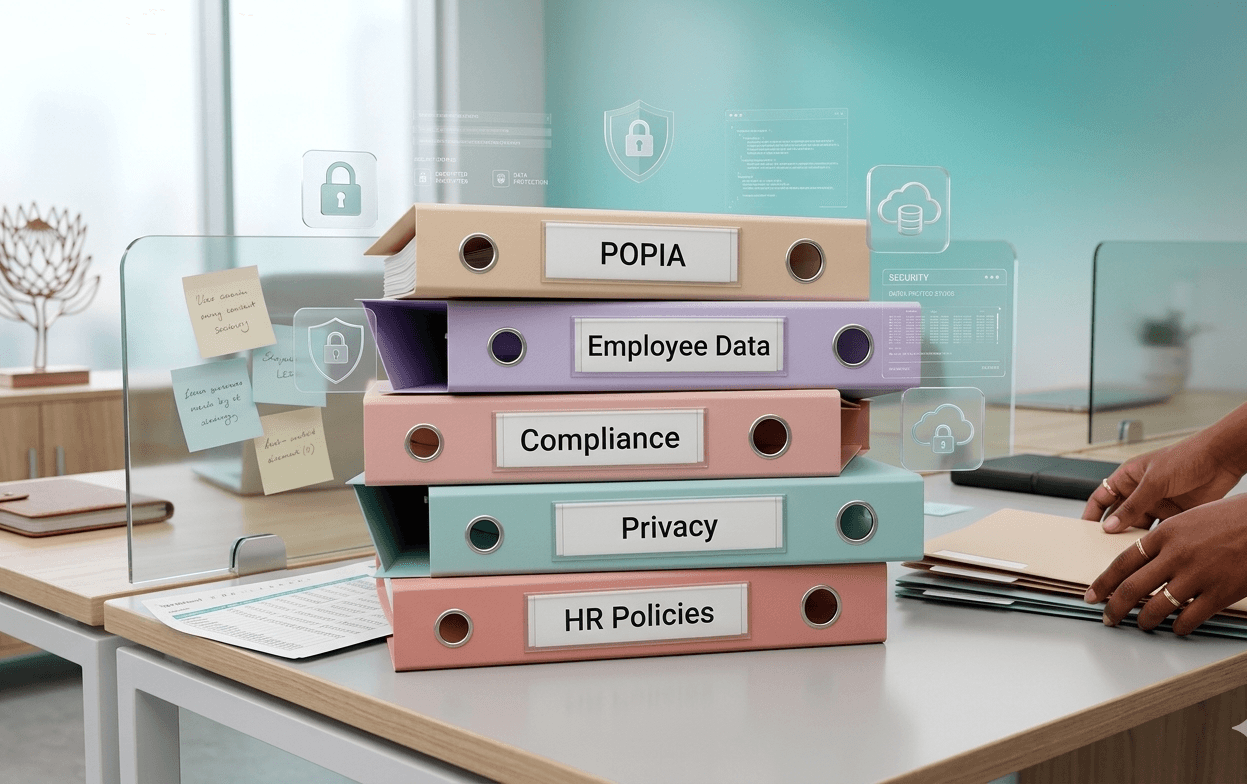
Storing employee data in spreadsheets, email folders, and WhatsApp groups creates the fragmented data risk that exposes South African employers to POPIA penalties of up to R10 million.
What Employee Data Are You Responsible For?
If your business holds any of the following, you have POPIA obligations around how it is stored, accessed, retained, and deleted:
Identity & Contact
Full name, ID/passport number, address, personal email, phone number
Employment Records
Contract of employment, job title, reporting structure, remuneration
Payroll & Banking
Bank account details, salary, deductions, tax certificate (IRP5)
Leave & Attendance
Leave balances, sick leave history, attendance records
Performance
Appraisal records, 360-degree reviews, PIP documentation
Disciplinary
Warnings, misconduct records, CCMA case files, suspension records
Health Information
Medical certificates, disability disclosures, occupational health records
Training & Skills
Qualifications, certifications, training completion records
The 8 Conditions of POPIA Compliance
POPIA's Chapter 3 establishes 8 conditions that must be met when processing personal information. Failing any single condition creates legal exposure.
Accountability
A "responsible party" must be appointed - typically your HR Manager or a designated Information Officer registered with the Information Regulator.
Processing Limitation
You may only collect personal information with the employee's knowledge and consent, or where another lawful ground exists (e.g., statutory requirement for payroll records).
Purpose Specification
Data must be collected for a specific, defined, and legitimate purpose. You cannot collect an employee's home address for one purpose and then use it for another.
Further Processing Limitation
You cannot share or further process employee data in a way that is incompatible with the original purpose. Sharing payroll data with a third party for a purpose the employee didn't consent to is a breach.
Information Quality
Data must be accurate, complete, and up to date. Outdated employee records or incorrect bank details that cause harm to the employee can constitute a breach of this condition.
Openness
Employees must be told what data you hold, why you hold it, and their rights regarding it. This is typically achieved through a Privacy Notice distributed to all staff.
Security Safeguards
You must take appropriate technical and organisational measures to secure personal data. This includes access controls, encryption, backup procedures, and breach response plans.
Data Subject Participation
Employees have the right to request access to their personal information you hold, request corrections, and object to processing in certain circumstances. You must have a process to respond to these requests.
Special Categories of Employee Information (Section 26)
Beyond ordinary personal information, POPIA's Section 26 creates a higher protection tier for categories of data that carry elevated risk of discrimination or harm. Employers regularly collect these categories without realising they require stricter controls or explicit consent.
Racial and ethnic origin
Collected for EEA reporting purposes. Permitted under the Employment Equity Act, but must be processed strictly for that statutory purpose and not shared or used beyond it.
Health and medical information
Medical certificates, disability disclosures, occupational health assessments, and HIV/AIDS status. Access must be restricted to HR and the direct manager where operationally necessary. Sharing health data with line managers without a clear operational need is a breach.
Biometric data
Fingerprint scanners and facial recognition time-and-attendance systems collect biometric information under Section 26. This requires explicit written consent from each employee before the system is activated for their profile. Retrofitting consent after deployment is legally precarious.
Criminal behaviour
Records of criminal convictions or alleged offences. Required for regulated industries (financial services, childcare, security) but must be obtained lawfully through an authorised screening provider and stored with strict access controls.
Religious and philosophical beliefs
Relevant for workplace accommodation (prayer breaks, dietary requirements, religious holidays). Collecting this information requires a clear lawful purpose and explicit consent.
Trade union membership
Required for bargaining council, UIF, and payroll deduction purposes. However, sharing union membership data with a third-party payroll bureau requires a written operator agreement under Section 21.
Practical implication for HR
If your time-and-attendance system uses biometric fingerprint readers and you have not obtained written consent from each employee, your organisation is currently in breach of Section 26. Verbal acknowledgement during onboarding is not sufficient - you need a signed consent document that specifically identifies the biometric system, its purpose, and the retention period.
Penalties: R10 Million or 10 Years Imprisonment
R10M
Maximum administrative fine the Information Regulator can impose on an organisation for a POPIA offence.
10 yrs
Maximum imprisonment for certain POPIA offences - applicable to individuals (directors, Information Officers) not just the organisation.
In addition to regulatory penalties, employers face civil liability if employees or former employees suffer harm as a result of a data breach. A hacked payroll system exposing bank account numbers creates both regulatory and civil exposure simultaneously.
The Information Regulator issued its first enforcement notice in 2022 against the Department of Justice after a ransomware attack. Since then, enforcement activity has been accelerating. The Regulator has made clear that ignorance of POPIA's requirements is not a mitigating factor.
Third-Party Operators: Your Obligations to Payroll Bureaus and Cloud Vendors
Under POPIA, any third party that processes personal information on your behalf is called an "operator". Sections 20 and 21 impose specific obligations on how you engage with operators - and make clear that you (the responsible party) remain legally accountable even if an operator causes the breach.
Payroll bureaus
Process IRP5s, salary runs, and tax filings on your behalf. Hold full copies of employee banking, salary, and tax data.
HR software platforms
Store employee records, documents, leave balances, and performance reviews in their cloud infrastructure.
Benefits administrators
Medical aid, provident fund, and group life administrators hold health information and beneficiary details.
Background screening companies
Conduct criminal, credit, and qualification checks - collecting sensitive information and returning results to you.
Occupational health providers
Conduct pre-employment and periodic medical assessments. Hold health records on your behalf after each assessment.
Cloud storage providers
If employee files are stored on Google Drive, Dropbox, or SharePoint, these providers are operators processing personal information on your behalf.
What Section 21 requires for every operator relationship
Most South African SME employers have never issued a formal data processing agreement (DPA) to their payroll bureau. If your payroll provider suffers a breach and employee banking details are exposed, you - as the responsible party - will face enforcement action from the Information Regulator regardless of whether the breach originated at the bureau.
How Fragmented HR Systems Increase Your POPIA Risk
Most SME employers in South Africa store employee data across multiple disconnected systems simultaneously: a payroll platform, a leave spreadsheet, an HR document folder shared over email, a WhatsApp group with sensitive communications, a physical filing cabinet, and possibly a third-party payroll bureau with its own copy of your employee data.
Each of these creates independent POPIA risk. You cannot demonstrate Condition 7 (Security Safeguards) if your employee IRP5 documents are sitting in a shared Google Drive folder accessible to anyone with the link. You cannot demonstrate Condition 5 (Information Quality) if the same employee's banking details are stored differently in three different systems.
The fragmented data risk matrix
5 Steps to POPIA Compliance for Your HR Data
Appoint and register an Information Officer
Every organisation that processes personal information must appoint an Information Officer and register them with the Information Regulator at www.justice.gov.za. In an SME, this is typically the HR Manager, Office Manager, or a director. This is a legal requirement - not optional.
Complete a Personal Information Audit (Data Mapping)
Map every location where employee data is stored - digital and physical. Document what data is held, the lawful basis for holding it, who has access, how it is secured, and when it will be deleted. This audit is both a compliance exercise and your evidence base if you are ever investigated.
Issue an Employee Privacy Notice
All employees (current and new) must receive a Privacy Notice explaining what personal information you hold, why, how long you keep it, who you share it with, and how they can exercise their rights. This notice must be written in plain language, not legal jargon.
Implement technical and organisational security measures
This means role-based access controls (only HR can see payroll data), encryption for sensitive documents, a clear password policy, a data breach response procedure, and regular audits of who has access to what. Condition 7 requires that you can demonstrate these measures - not just assert them.
Establish a retention and deletion schedule
POPIA requires that personal information is deleted or anonymised when it is no longer needed for its original purpose. The BCEA requires employment records to be kept for 3 years minimum. Set a clear retention schedule: what is kept, for how long, and how it is deleted. Document this in your data processing register.
Employee Rights Under POPIA: What Your Staff Can Demand
POPIA's Condition 8 (Data Subject Participation) gives employees specific rights regarding the personal information you hold about them. Receiving a subject access request from a current or former employee without a defined process to respond is itself a compliance failure.
Right to access
Employees can request a copy of all personal information you hold about them. You must respond within a reasonable period - typically 30 days for formal requests under PAIA. This includes performance reviews, disciplinary records, payroll history, medical certificates, and HR notes.
Right to correction
If an employee believes their information is inaccurate, incomplete, or outdated, they can request that you correct or update it. You must either make the correction or provide a written explanation of why you decline to do so.
Right to object
Employees can object to the processing of their personal information on reasonable grounds relating to their specific situation - for example, objecting to their contact details being shared with a third-party wellness provider they did not consent to.
Right to deletion
When employment ends, employees can request that personal information no longer needed for a lawful purpose be deleted or destroyed. However, you are entitled to retain records required by law (BCEA minimum: 3 years for employment records).
Right to lodge a complaint
Employees can lodge a complaint directly with the Information Regulator at inforegulator.org.za if they believe you have processed their data unlawfully. The Regulator can investigate and impose fines without requiring a court process.
Practical tip: build a subject access request process before you receive one
A subject access request from a recently dismissed employee is frequently a precursor to a CCMA dispute - they are gathering your records before filing. Having a documented, prompt response process demonstrates compliance and reduces your legal exposure on both the data protection and labour relations fronts simultaneously.
Data Breach Notification: When and How to Report
Section 22 of POPIA requires you to notify both the Information Regulator and affected employees "as soon as reasonably possible" after discovering that personal information has been compromised. Unlike the EU's GDPR - which mandates a strict 72-hour window - POPIA does not specify an exact timeframe. However, the Information Regulator has indicated that delays beyond 72 hours without documented justification will be treated as aggravating factors in enforcement.
A "security compromise" under POPIA is broader than most employers realise. It includes not only ransomware attacks and database intrusions, but also: accidentally emailing payslips to the wrong recipient, an employee's laptop containing personnel files being stolen, a disgruntled employee downloading the HR database before resigning, and shared drive links sent to external parties without access controls.
Breach response sequence
What the Information Regulator evaluates
In published guidance, the Regulator assesses three questions: (1) Did the responsible party have appropriate security measures in place before the breach? (2) Was notification made promptly? (3) Did the responsible party take adequate steps to contain and remediate? Employers who can demonstrate yes to all three face significantly reduced penalty risk.
How Long Must You Keep Employee Records?
This is the POPIA question employers ask most often, and it has an awkward answer: POPIA says delete, labour and tax law say keep. Section 14 requires that personal information is not retained any longer than is necessary for the purpose it was collected for - unless another law requires it to be kept. For employment records, another law almost always does.
So the rule in practice is: identify every law that touches the record, keep it for the longest period any of them requires, and delete or anonymise it after that. Keeping everything forever is the breach most employers are actually committing.
| Record | Keep for | Under |
|---|---|---|
| Employee particulars: name, occupation, time worked, remuneration | 3 years from the date of the last entry | BCEA s31 |
| Payroll and anything supporting a tax return | 5 years from submission of the return | Tax Administration Act s29 |
| Employment equity records | For the period the EEA prescribes for your reporting cycle | Employment Equity Act |
| Records of a dispute, hearing or dismissal | At least 3 years - the employer carries the onus of proving fairness | LRA |
| Unsuccessful job applicants | Only as long as the recruitment purpose lasts, unless consent was given to keep them on file | POPIA s14 |
| Anything else with no legal retention period | Delete or anonymise once the purpose ends | POPIA s14 |
Two traps sit inside that table. The first is the unsuccessful applicant. A CV sent for one advertised role was collected for that role. Holding it in a folder for two years “in case something comes up” is processing without a lawful basis unless the applicant agreed to it - and it is trivially easy for them to prove, because they never applied again.
The second is the special-category record. Medical certificates supporting sick leave, disability information, union membership and disciplinary records about someone's alleged criminal behaviour all carry the heavier Section 26 to 33 protections. They should be stored separately from the general employee file, with narrower access - a shared HR drive that every manager can open fails this test even if nobody has actually misused it.
The practical version: set a retention period per record type, write it down, and make the deletion happen on a schedule rather than when somebody remembers. A documented retention policy that you actually follow is one of the strongest mitigating factors the Information Regulator weighs when a breach does occur.
Where these records come from
Most of the retention obligations above are created by documents produced elsewhere in the employee lifecycle. The employment contract starts the BCEA s31 record. Sick notes collected against the sick leave balance are special-category data from the moment they arrive. A written warning and the section 189 consultation record both need to survive at least three years, because the employer carries the onus of proving fairness. And the UI-19 closes the file at the end.
How Synthro Helps You Stay POPIA Compliant
Synthro centralises all employee data in a single, audited, role-controlled system - eliminating the fragmented data risk that exposes most South African employers to POPIA liability.
Role-based access control
Define exactly who can see payroll data, performance records, or disciplinary files - down to individual role level.
Complete audit trail
Every view, edit, export, and download of employee data is logged with timestamp and user ID - satisfying Condition 7.
Document lifecycle management
Retention schedules built in. Automated archival and deletion prompts ensure you don't keep data longer than required.
Data subject access requests
NALA can generate a full data extract for any employee on request - responding to Condition 8 requests in minutes, not days.
POPIA Compliance Checklist for South African Employers
Use this checklist to assess your current POPIA posture. Each unchecked item represents active legal exposure that should be resolved before the Information Regulator investigates.
Registration & Governance
Data Inventory & Legal Basis
Employee Notices & Consent
Technical Security
Retention & Deletion
Breach Preparedness
If more than five items above are unchecked, your organisation has material POPIA compliance gaps. Prioritise Registration and Technical Security categories first - these are the areas the Information Regulator most commonly cites in its enforcement actions.
Twenty-three points, and who owns each one
The checklist above as an editable Word document and print-ready PDF, so you can work through it offline or hand it to whoever owns compliance. It goes to your inbox, so you still have it the next time this comes up.