Two calculations, one Fund - and they are not the same sum
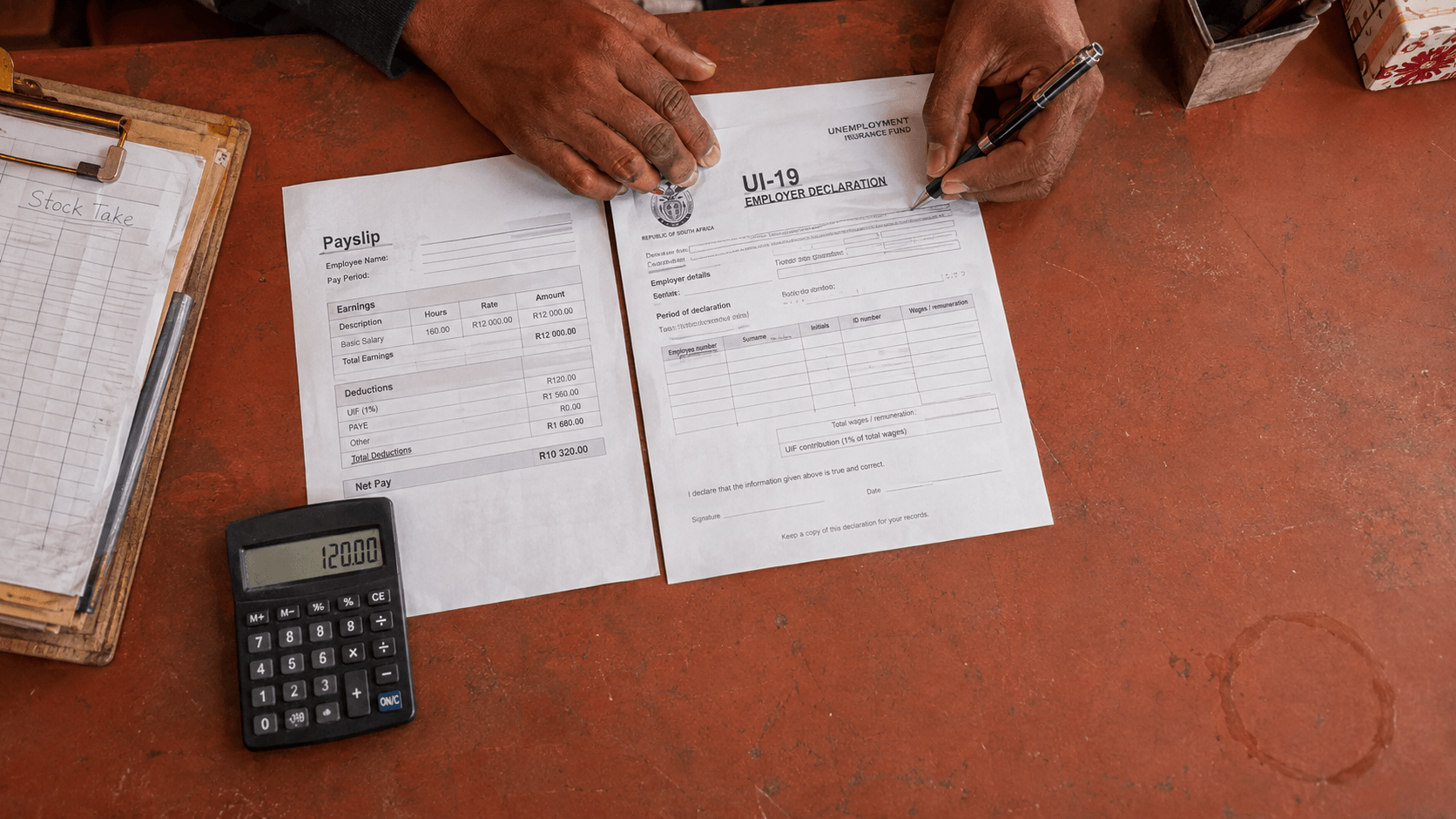
Almost every UIF question is really one of two questions, and they share only a ceiling. An employer running payroll wants to know what UIF costs this month. Someone who has just been retrenched wants to know what the Fund will actually pay them. This tool answers both, because in practice the same person is often asked both in the same week - an employer handing over a UI-19 gets asked “so how much will I get?” across the desk.
The contribution: 1% + 1%, and where it stops
The Unemployment Insurance Contributions Act sets a flat 2% of remuneration, split evenly. The employee’s 1% comes off the payslip; the employer’s 1% is a cost on top of salary. Both are calculated on remuneration capped at R17,712 per month - a ceiling that has not moved since 1 June 2021.
Monthly UIF contribution
contributory earnings = min(remuneration, R17,712) · employee = 1% · employer = 1%
That makes the maximum R177.12 each, R354.24 in total, per employee per month. An employee on R60,000 costs exactly the same in UIF as one on R17,712 - which is why the line is flat on every payslip above the ceiling and why a spreadsheet that forgets the cap over-deducts quietly for years.
“Remuneration” is broader than basic salary: it includes regular allowances and commission, and excludes reimbursement of actual expenses. It is paid to SARS on the EMP201 alongside PAYE and SDL, by the 7th of the following month, and employee details must be declared to the UIF every month - not only when someone leaves.
The benefit: why it is almost never 60%
The most repeated claim about UIF is that it pays 60% of your salary. It pays between 38% and 60%, on a sliding scale set out in Schedule 3 of the Unemployment Insurance Act, and the scale is deliberately generous at the bottom and thin at the top:
Income replacement rate - UI Act, Schedule 3
daily income = capped remuneration ÷ 30.4 · IRR% = 29.2 + (7,173.92 ÷ (daily income + 232.92))
The result is clamped to a floor of 38% and a ceiling of 60%. Because the salary itself is capped first, anyone earning above R17,712 lands at roughly 38% of a capped income - so the higher the salary, the further the benefit falls from what people expect. Maternity is the one exception written into the Act: it is paid at a flat 66%, not on the sliding scale.
A worked example you can check by hand
An employee earning R12,000 a month on a five-day week, retrenched after 24 months of contributions:
UIF unemployment benefit - R12,000/month, 5-day week, 24 months contributed
| Daily income | R12,000 ÷ 30.4 | R394.74 |
| Replacement rate | 29.2 + (7,173.92 ÷ (394.74 + 232.92)) | 40.63% |
| Daily benefit | R394.74 × 40.63% | R160.38 |
| Credit days | 24 months × 5 days × 52 ÷ 12 ÷ 4 | 130 days |
| Total benefit over the claim | 130 × R160.38 | R20,849.40 |
Credit days: the part that ends the payment early
A UIF claim does not run for as long as you are unemployed. It runs for as long as your credit days last, and credit accrues at one day for every four days worked while contributing, capped at 365. The practical consequences catch people out:
- Four years of work buys the maximum. Roughly four years of continuous contributions reaches 365 credit days. Contributing for fifteen years does not buy more - the cap is absolute.
- Eight months of work does not buy eight months of UIF. It earns about 43 credit days - six weeks of payment, not two thirds of a year.
- Credits are spent, not reset. Days used in a previous claim inside the four-year cycle are gone. A second retrenchment in three years pays far less than the first.
- It is paid monthly, never as a lump sum, and the claimant must keep confirming continued unemployment on uFiling or at the labour centre.
The employer’s side of a claim: the UI-19 decides it
Whatever the arithmetic says, a claim is approved or rejected on the strength of what the employer declared. Two employer failures block more claims than any calculation:
- The wrong termination code. Code 1 (resignation) does not qualify for unemployment benefits; code 11 (retrenchment) does. A code entered carelessly on the UI-19 is the single most common reason a retrenched employee is turned away.
- Arrears or undeclared months. The Fund pays on its own record of declared remuneration. Months an employer never declared simply do not exist as credit, and the former employee finds out at the labour centre.
The claim must be lodged within six months of the last day of employment. If the exit is a retrenchment, work out the severance and notice with the retrenchment package calculator and run the whole last day against the final pay checklist - UIF is one line in a longer list of things owed.
Who does not contribute
Employees working under 24 hours a month for an employer; learners on a Skills Development Act learnership; national and provincial public servants; and people admitted to South Africa to work under a contract requiring repatriation. Everyone else contributes - including domestic workers, part-timers above 24 hours, and employees on fixed-term contracts.
The whole method in one block - copy it for your accountant, your records, or an AI assistant
SOUTH AFRICAN UIF - CONTRIBUTION AND BENEFIT, THE STATUTORY METHOD

THE CEILING (both sides)
R17,712 per month of remuneration. Unchanged since 1 June 2021.
Everything below is calculated on the CAPPED figure, never the gross.

1. CONTRIBUTION (Unemployment Insurance Contributions Act)
   Employee: 1% of capped remuneration -> max R177.12/month
   Employer: 1% of capped remuneration -> max R177.12/month
   Total to SARS: 2% -> max R354.24/month per employee
   Paid on the EMP201 with PAYE and SDL by the 7th of the following month.
   Remuneration includes regular allowances and commission; it excludes
   reimbursement of actual expenses.

2. BENEFIT (Unemployment Insurance Act, Schedule 3)
   daily income = capped monthly remuneration / 30.4
   IRR%         = 29.2 + (7,173.92 / (daily income + 232.92))
   IRR% is clamped to a MINIMUM of 38% and a MAXIMUM of 60%.
   daily benefit = daily income x IRR%
   MATERNITY IS THE EXCEPTION: flat 66%, not the sliding scale.

3. CREDIT DAYS (how long it is paid for)
   1 credit day per 4 days worked while contributing, capped at 365.
   ~4 years of contributions = the maximum 12 months of cover.
   Paid in monthly instalments, never as a lump sum.
   Claim within 6 months of the last day of employment.

WORKED EXAMPLE - R12,000/month, 5-day week, 24 months contributed
- Capped remuneration:  R12,000 (under the ceiling)
- Daily income:         12,000 / 30.4        = R394.74
- IRR:  29.2 + (7,173.92 / (394.74 + 232.92)) = 40.63%
- Daily benefit:        394.74 x 0.4063      = R160.38
- Days worked:          24 x (5 x 52) / 12   = 520
- Credit days:          520 / 4              = 130
- Total benefit:        130 x 160.38         = R20,849.40

THE THREE THINGS PEOPLE GET WRONG
1. "UIF pays 60%." It pays 60% only at the very bottom of the scale.
   At the ceiling it is ~38%.
2. "I worked 8 months so I get 8 months of UIF." No - 8 months earns about
   43 credit days, roughly six weeks of payment.
3. Resignation (UI-19 code 1) does not qualify for unemployment benefits.

Source: Synthro - UIF Calculator (South Africa)
https://www.synthro.io/tools/uif-calculator-south-africa
Figures last verified August 2026 against the UIF ceiling and Schedule 3.
About this calculator
Contributions follow the Unemployment Insurance Contributions Act (1% + 1% on remuneration capped at R17,712 a month, unchanged since 1 June 2021). Benefits follow Schedule 3 of the Unemployment Insurance Act - the 38%–60% sliding replacement rate, the ÷30.4 daily conversion, one credit day per four days worked and the 365-day cap - with maternity at the statutory flat 66%. Figures last verified August 2026. The benefit figure is an estimate: the Fund calculates the final amount from its own record of declared remuneration. This is a calculation tool, not legal or financial advice.