The Question Isn't AI or Consultant - It's Which Part of Your HR Needs Which
Last year, a Johannesburg business owner called us three days after receiving a CCMA Form 7.11 - a Notice of Referral for unfair dismissal. They had issued a written warning. They had held a disciplinary hearing. They had a signed contract on file. What they didn't have was a PIP with a support plan section before the final warning - a procedural gap the commissioner identified immediately. The employee walked away with R78,000. The employer walked away with a lesson that cost them the equivalent of six years of AI HR software fees.
That story repeats itself across South Africa more often than anyone talks about. SMEs - the ones without a dedicated HR person, where the owner or office manager handles HR between everything else - are not losing CCMA cases because they're bad employers. They're losing because HR in a busy small business gets done reactively: the document drafted the night before the hearing, the contract updated when someone asks a question, the leave payout calculated when a resignation dispute is already in motion.
The honest answer to "AI or consultant?" is: both, in the right places. AI handles the day-to-day compliance work that most small businesses currently do poorly or skip entirely. A qualified human consultant handles the situations where the outcome depends on representation, negotiation, or judgment that only comes from experience. Understanding which situation needs which is what this guide is actually about.
The split, in plain terms
AI handles the high-frequency daily work: leave management, document generation, compliance questions, monitoring deadlines. That's roughly 80% of what HR in a small business actually requires. A human consultant handles the 20% where the stakes are highest: CCMA hearings, retrenchment negotiations, complex misconduct, anything involving a legal document. For most SA SMEs, running both costs less - and carries significantly less risk - than trying to run either alone.
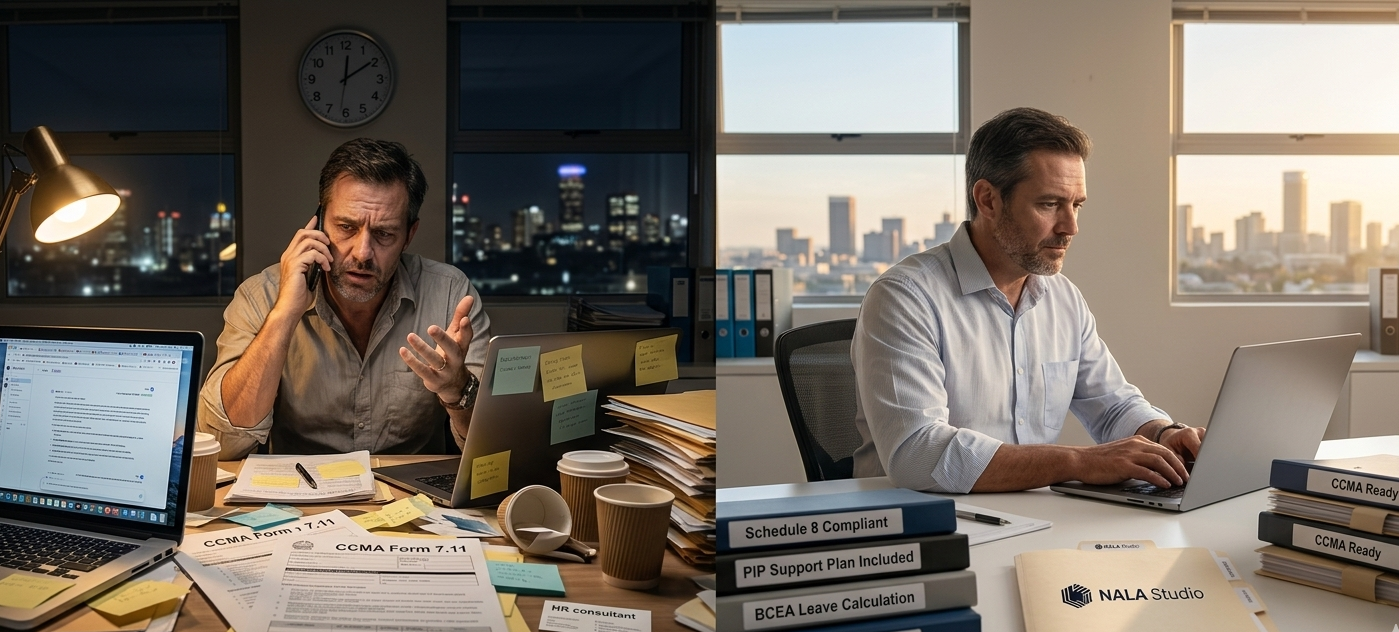
AI handles documentation and compliance checks 24/7 - human consultants are needed for complex disputes and negotiations.
What a Human HR Consultant Does That Software Cannot
There are things a qualified South African labour consultant can do that no AI will be able to do - not this year, and not next year either. Being clear about what those things are is not a knock on AI. It's what prevents you from walking into a CCMA hearing having relied on the wrong tool at the wrong moment.
CCMA representation
A qualified labour consultant or attorney can appear alongside you at CCMA conciliation and arbitration hearings. The outcome of those hearings is shaped by preparation, legal argument, and how evidence is presented - things that happen in the room, in real time. AI cannot appear at the CCMA. This is not a current limitation; it is a permanent one.
Judgment when the facts are disputed
When an employee's version and the employer's version contradict each other, when the law is genuinely ambiguous, or when a situation has no clear precedent, experienced human judgment matters in ways that AI cannot replicate. A consultant who has handled hundreds of CCMA cases can read a situation - and give you an honest assessment of your exposure - that no algorithm can.
Negotiation and relationship management
Retrenchment negotiations, settlement discussions, union interactions, and collective bargaining require human presence, tone, and relationship skills. A consultant who knows how a specific CCMA commissioner operates, or has a working relationship with a shop steward, brings a form of value that has nothing to do with legal knowledge and everything to do with being a person in a room.
Independent investigations
Sexual harassment complaints, serious misconduct investigations involving senior staff, or any matter where the company's credibility as an employer depends on the process being seen as fair - these require an independent, trained human investigator. The appearance of independence is itself a legal requirement in many of these cases.
Department of Labour relationships
Experienced HR consultants often have working relationships with Department of Labour inspectors, CCMA commissioners, and SETA representatives. When an unannounced inspection arrives or a B-BBEE audit gets complicated, a consultant who has navigated those relationships before is a significant advantage.
What AI Gets Right - And Gets Right Every Time
AI does not make HR less human. What it does is remove the friction that makes small businesses skip the compliance steps they know they should be taking. The document that didn't get generated because it felt like too much admin. The BCEA question that didn't get asked because it was a Sunday. The leave calculation that got estimated rather than properly calculated. AI eliminates those gaps - consistently, at any hour, without a billable rate.
BCEA and LRA answers at 10pm on a Sunday
The compliance question your manager has at 9pm gets answered at 9:01pm - not at a R1,500 hourly rate on Monday morning after the decision has already been made. This matters more than it sounds: most HR errors in small businesses happen because someone acted without checking first. Remove that friction and you remove most of the risk.
Every document generated with the right elements, every time
Written warnings, PIPs, disciplinary notices, employment contracts, suspension letters - all generated with the legally required elements built in, pre-filled from the employee's HR record, and filed with a timestamp. The written warning that takes 45 minutes to draft manually takes 60 seconds. The PIP that would have been skipped because it felt like too much admin gets done before the performance conversation.
Leave calculations your payroll won't dispute
BCEA-accurate accruals, the 36-month sick leave cycle tracked from each employee's actual start date, annual leave calculated on the correct basis, and resignation payouts done in seconds. The disputes that flare up when someone resigns and challenges their leave payout almost always come from a spreadsheet that wasn't updated or a formula that wasn't checked against the BCEA.
Compliance deadlines you won't miss
NMW review dates, probation review deadlines, WSP/ATR submission windows, contract renewal dates - flagged automatically before they become problems. No consultant is monitoring your calendar proactively. A system is.
Workforce patterns a spreadsheet can't see
Leave abuse patterns, early burnout signals, and performance trends across your entire team - surfaced before they escalate to formal HR processes. The manager with 15 direct reports and a Monday morning meeting can't see what's building. The AI can.
The Cost Reality: R1,050/month vs R5,000–R15,000/month
The numbers are not complicated. What gets complicated is understanding which tool handles which type of work - and what it actually costs your business when you use the wrong one in the wrong situation.
| Service | Cost | Response Time | Availability |
|---|---|---|---|
| Human HR consultant (retainer) | R5,000–R15,000/month | Hours to days | Business hours |
| Human HR consultant (ad hoc) | R1,000–R3,500/hour | Days to weeks | Business hours |
| Synthro Basic (AI HR assistant) | R1,050/month (15 users) | Seconds | 24/7 |
| Synthro Premium (AI HR + analytics) | R3,000/month (15 users) | Seconds | 24/7 |
What most SA SMEs actually do
AI at R1,050/month handles daily compliance, document generation, leave management, and BCEA questions. A consultant on an ad hoc basis at R1,000–R3,500/hour handles CCMA appearances and serious misconduct. The total annual spend is often lower than a consultant retainer alone - while providing substantially more consistent daily compliance coverage than either option provides in isolation.
When You Need a Person, Not a Platform
These situations have one thing in common: the outcome depends on a human being in the right place at the right time, with the right credentials and relationships. No template, subscription, or AI assistant changes that.
Get a human consultant for:
- •You've received a CCMA Notice of Referral (Form 7.11) - get a consultant before the conciliation date
- •Retrenchment of 4 or more employees - Section 189A consultation requirements apply
- •A sexual harassment complaint has been formally lodged - an independent investigator is a legal requirement
- •A union is demanding recognition or actively organising your workforce
- •An employee has raised a formal discrimination claim under the Employment Equity Act
- •You've received a Department of Labour inspection notice
- •The dispute involves a senior employee, a director, or a high-value compensation claim
- •Any hearing where the potential CCMA award exceeds what you would pay a consultant to prevent it
When AI Is the Right Call
The value AI brings to HR in a small business is not about replacing expertise. It's about closing the gap between when you need something and when you get it. Most HR errors in South African SMEs happen in that gap - in the hours between the situation arising and the consultant being available to advise on it.
Use AI when:
- •It's 9pm and a manager needs to know if what happened this afternoon is grounds for dismissal
- •You need a written warning drafted and ready for a disciplinary process tomorrow morning
- •You're not sure if your current employment contracts cover all 8 BCEA-mandated minimum terms
- •You need to check the current NMW rate and whether your lowest-paid employee is still compliant
- •An employee has taken 4 weeks of sick leave and you need to know exactly where their 36-month cycle stands
- •A performance conversation is happening at 2pm and you need a CCMA-compliant PIP framework right now
- •An employee has resigned and is disputing their leave payout - you need the BCEA-accurate calculation
- •You need a B-BBEE affidavit for a tender submission and the deadline is tomorrow
The Combination That Works: How to Split the Work
For a South African SME with 15–50 employees, the question isn't which tool to use - it's knowing which work belongs to which. The split happens naturally once you see it: AI for the daily administrative compliance that most businesses currently do poorly or skip entirely, and a consultant for the moments where being represented by a qualified professional changes the outcome.
| Situation | Who handles it | Why |
|---|---|---|
| Employee asks about leave entitlement at 9pm | AI | Instant, accurate, no billable hours |
| Written warning for first misconduct | AI | Generates compliant document in 60 seconds |
| Leave calculation on resignation | AI | Instant from integrated HR record |
| Disciplinary hearing for serious misconduct | AI + Human review | AI generates the notice and record; human advises on strategy |
| CCMA conciliation or arbitration | Human consultant | Representation requires a qualified person |
| Retrenchment of more than 3 employees | Human consultant | Section 189 process requires specialist guidance |
| PIP for underperforming employee | AI | Generates CCMA-compliant PIP in 60 seconds |
| Union recognition agreement | Human consultant | Collective bargaining requires labour relations experience |
| NMW compliance check across payroll | AI | Automated monitoring and flagging |
| Sexual harassment investigation | Human consultant | Requires an independent, trained investigator |
The pattern across the table is consistent: AI handles what happens every week. Humans handle what could end up at the CCMA. At a fixed monthly cost for AI and an ad hoc rate for consultants, most SA SMEs find this combination costs less annually than a consultant retainer alone - and builds the documentation discipline that actually wins disputes when they arise.
One Avoided CCMA Case Covers 6.7 Years of AI HR
The financial case for AI HR is most visible when you measure what it prevents rather than what it costs.
Why most employers lose cases they should win
The CCMA does not primarily find against employers because the dismissal was substantively wrong. It finds against them because the procedure was flawed: a warning was missing, a PIP had no support plan section, a hearing record was incomplete, or notice wasn't issued in time. These are documentation failures - and documentation failures are exactly what AI prevents.
That figure uses a single avoided case. The real return compounds every time a written warning closes a disciplinary process without escalating, every time a PIP creates a paper trail that makes a performance dismissal defensible, every time an employment contract doesn't hand an employee a constructive dismissal claim two years down the line.
Most South African SMEs will face at least one formal CCMA referral in any five-year period. The businesses that win those cases are not the ones with the most expensive legal representation. They are the ones with the best documentation - documentation that was built before the dispute, not assembled in a panic after the Form 7.11 arrived.
Next Read
See what AI does in 60 seconds
A concrete breakdown of 5 specific HR tasks - written warnings, leave calculations, PIPs, onboarding packs, and B-BBEE affidavits - showing exactly how AI reduces each from hours to seconds.
Frequently Asked Questions
Can AI completely replace a human HR consultant for a South African SME?
For day-to-day HR administration - leave management, document generation, compliance monitoring, and answering BCEA questions - AI handles the majority of the work effectively. It cannot replace a human for CCMA appearances, retrenchment negotiations, complex misconduct investigations, or situations requiring legal representation. Most SA SMEs benefit from using both: AI for the high-frequency daily work, and a consultant on an ad hoc or retainer basis for situations requiring representation or specialist strategy.
How much does a human HR consultant cost in South Africa vs AI HR software?
Human HR consultants typically charge R1,000–R3,500 per hour for ad hoc work, or R5,000–R15,000 per month on retainer. Synthro Basic costs R1,050 per month for up to 15 users - R12,600 per year - with 24/7 AI HR access included. Many SA SMEs find that combining an AI platform for daily work with occasional consultant access for CCMA matters is less expensive than either option used exclusively.
What is the most common reason South African employers lose at the CCMA?
Procedural failures account for the majority of unfair dismissal findings where the employer was substantively in the right. The most common are: not issuing a warning before dismissal, issuing a warning with missing required elements, not having a signed CCMA-compliant PIP with a support plan section, not having a disciplinary hearing record, and not providing the employee with notice of the hearing in time to arrange representation. AI HR systems prevent these failures by generating compliant documents consistently.
What should I look for in an AI HR assistant for South African businesses?
Look specifically for: training on South African legislation (BCEA, LRA, EEA, B-BBEE Act, POPIA, NMW Act) rather than global HR frameworks; ability to generate CCMA-compliant documents; leave management that correctly implements the BCEA 36-month sick leave cycle; and data residency in South Africa for POPIA compliance. A generic global HR platform that does not explicitly address South African legal requirements will leave compliance gaps.
When does a small South African business need a dedicated HR person rather than AI tools?
The decision depends on headcount, complexity, and the frequency of labour relations issues. At around 50 employees, the volume of HR work typically justifies a part-time or full-time HR professional. Below that threshold, AI handles most administrative HR work, with occasional consultant support for complex matters. A business with frequent disciplinary issues or an active union relationship may need dedicated HR support earlier. AI and a dedicated HR professional are not mutually exclusive - many HR professionals use AI tools to handle documentation so they can focus on people management.