Before You Start: The Critical Limitation
ChatGPT was trained on global data. Ask it about sick leave and it may give you a UK or Australian entitlement without knowing the BCEA's 36-month sick leave cycle. Ask it to draft a written warning and it may produce something plausible without including the five Code elements the CCMA requires. Ask it about retrenchment and it may not reference Section 189 consultation at all. That is the core risk - not that the output looks wrong, but that it can look right while being legally incomplete for South Africa.
Every prompt below forces South African legal context into the instruction. That narrows the gap significantly, but it does not close it entirely. ChatGPT will not automatically know whether a specific employee qualifies as fixed-term under Section 198B, or which Code requirements apply to your dismissal scenario. Treat the output as a high-quality starting point that still needs review before it goes to an employee.
Rule of thumb
If the output affects employee rights, dismissal risk, or contractual obligations, verify it against the BCEA, LRA, POPIA, or with a qualified HR practitioner before using it.
Why confidentiality matters here
South African employers also need to think about data handling, not just drafting quality. If you paste employee information into a public AI tool, you are not only asking for wording help. You are also deciding how personal information is processed.
In practical terms, avoid putting ID numbers, medical information, bank details, grievance details, disciplinary allegations, salary data, or other sensitive employee information into public AI systems unless your organisation has explicitly approved that workflow.
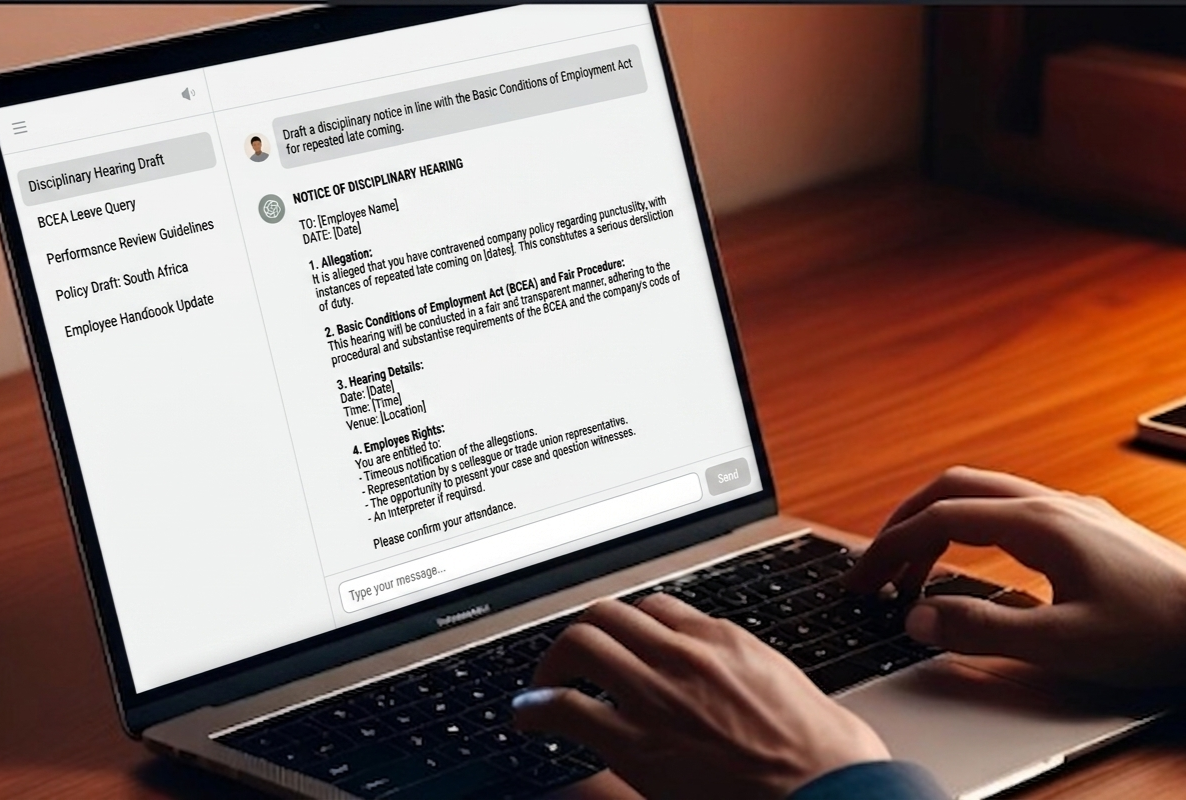
Grounding ChatGPT prompts in South African labour law produces far more useful HR outputs.
Build Better Prompts Before You Copy These
The biggest mistake HR teams make with ChatGPT is copying a broad request into the box and hoping the model fills in the rest. Better output usually comes from a simple structure.
- 1
Name the jurisdiction
State South Africa and reference the BCEA, LRA, CCMA, POPIA, or B-BBEE where relevant.
- 2
Define the role and scenario
Tell the model whether this is for an employer, HR manager, founder, or line manager and describe the exact issue.
- 3
Give the facts
Include dates, chronology, policy context, working pattern, and what has already happened.
- 4
Specify the output format
Ask for a letter, checklist, hearing notice, table, or policy draft so the result is easier to review.
- 5
Add a review instruction
Tell ChatGPT to flag assumptions, identify missing facts, or point out where human legal review is still required.
A better instruction to add at the end
Ask the model to list its assumptions, identify missing facts, and state where the output should be checked by a human before it is sent to an employee. That single line usually makes the draft more honest and easier to review.
Prompts 1 to 5
These first five prompts are mostly drafting and calculation tasks. They are good use cases for AI because the output has a clear structure, but they still need factual verification before you issue anything externally or load anything into payroll or employee records.
Prompt 1: Written Warning Letter
Write a BCEA-compliant written warning letter for a South African employer.
Employee name: [name]. Job title: [title].
Misconduct: [describe specifically what happened, with date].
This is the employee's [first/second] written warning.
Include: nature of misconduct, expected standard, consequence of repetition,
12-month validity period, and a signature section.
Format as a formal letter.
Prompt 2: Leave Entitlement Calculator
Under the South African BCEA, calculate the leave entitlements for an employee with
the following details:
- Start date: [date]
- Current or end date: [date]
- Working days per week: [number]
- Contract type: [permanent/fixed-term]

Calculate: annual leave accrued, sick leave entitlement (show 3-year cycle),
family responsibility leave remaining, and any leave payout owed on termination.
Prompt 3: PIP (Performance Improvement Plan)
Create a Performance Improvement Plan (PIP) for a South African employer that
complies with CCMA requirements for poor performance dismissal under the LRA.
Employee name: [name]. Job title: [title].
Performance issues: [describe specifically with examples and dates].
Required standard: [describe measurable target].
PIP duration: [30/60/90] days.
Include: three review milestones, support the employer will provide,
and a consequence clause if performance does not improve.
Prompt 4: Disciplinary Hearing Notice
Write a notice to attend a disciplinary hearing for a South African employee,
complying with LRA procedural fairness requirements.
Employee name: [name]. Job title: [title].
Charges: [describe specific charges].
Hearing date: [date and time]. Location: [location].
Include: employee's right to bring a representative (shop steward or fellow
employee), the name of the chairperson, and instructions on how to respond.
Prompt 5: B-BBEE Affidavit for EME
Draft a B-BBEE affidavit for an Exempt Micro Enterprise (EME) in South Africa.
Company name: [name]. Registration number: [number].
Annual turnover: [amount - must be under R10 million].
Ownership: [percentage black-owned].
The affidavit should confirm EME status under the B-BBEE Act and state the
automatic B-BBEE level based on ownership percentage.
Format as a sworn statement suitable for submission to clients.
Prompts 6 to 10
These prompts move into higher-risk territory because they affect rights, process, consultation, and dispute preparation. Use them to structure your first draft, not to bypass judgement.
Prompt 6: Retrenchment Consultation Notice (Section 189)
Draft a Section 189 retrenchment consultation notice for a South African employer
complying with the LRA.
Company name: [name]. Reason for retrenchment: [e.g., operational requirements].
Number of employees affected: [number]. Proposed retrenchment date: [date].
Include: the reason for proposed retrenchments, alternatives considered,
selection criteria, and severance pay calculation (1 week per completed year of service).
Prompt 7: Employment Contract Clause Check
Review the following clause from a South African employment contract and identify
any provisions that violate the BCEA or LRA. Indicate which section of the relevant
Act is breached and what the compliant version should say.

Clause: [paste the clause here]
Prompt 8: CCMA Conciliation Preparation
Help me prepare for a CCMA conciliation hearing as the employer (respondent).
The employee was dismissed for [reason].
The employee is claiming [unfair dismissal / constructive dismissal / unfair labour practice].
Summary of the facts: [describe what happened in chronological order].
What are the key arguments I should prepare, what documentation do I need,
and what is a reasonable settlement to consider given SA labour law?
Prompt 9: Job Description
Write a job description for a [job title] role at a South African SME in the [industry]
sector with [X] employees.
Key responsibilities include: [list 3-5 main duties].
The role reports to: [job title].
Include: purpose of the role, key performance areas, minimum qualifications,
and a BCEA-compliant note about hours and overtime.
Prompt 10: Workplace Policy
Write a [disciplinary / leave / IT usage / social media / remote work] policy
for a South African SME that complies with the BCEA and LRA.
The company has approximately [number] employees.
The policy must be clear enough for employees to understand their obligations
and specific enough to form the basis for disciplinary action if violated.
Include: the policy's purpose, who it applies to, the rules, and the consequences of non-compliance.
When Not To Use ChatGPT For HR
When the facts are contested
If two people tell different versions of the same event, the value comes from investigation and judgement, not drafting speed.
When the data is highly sensitive
Medical issues, disciplinary allegations, payroll details, identity numbers, and grievance records should be handled with extreme care.
When the business wants certainty
Retrenchments, dismissals, and high-value disputes still need human review because a polished answer can still be wrong.
When process matters more than wording
Many labour problems are caused by procedural mistakes, not bad grammar. AI can help draft documents, but it cannot run the process for you.
A Safe-Use Checklist for SA Employers
Always state South Africa and the relevant law in the prompt.
Remove names and identifying details wherever possible before pasting information into a public AI tool.
Ask for structured output: letter, checklist, table, or policy format.
Add the dates, context, and exact misconduct or issue you are dealing with.
Ask the model to list assumptions and missing facts before it finalises the draft.
Check every legal or procedural statement before using it with staff.
Review the output on three levels: facts, legal accuracy, and confidentiality risk.
Do not upload confidential employee information unless your AI usage policy allows it.
When Specialised Tools Help More Than Generic ChatGPT
Generic AI is strong at first drafts. It is weaker when you need South African HR context built in by default, or when the business needs consistency, workflow structure, and an operational record of what was produced.
Use ChatGPT when you want a fast draft and you have the judgement to review it. Use specialised HR tooling when you want the workflow, context, and structure already aligned to South African HR operations.
Best workflow
Start with one or two of these prompts if you are experimenting. Once the work becomes repeatable and business-critical, it usually makes sense to move it into a purpose-built HR workflow so the output, records, and review steps live in one place.
See how NALA supports SA HR workflowsFAQ
Can I use ChatGPT to draft disciplinary documents?
Yes, as a first draft. But you should still verify that the facts, wording, and process align with the BCEA, LRA, your internal policy, and the employee situation before issuing anything.
Can ChatGPT calculate leave under the BCEA?
It can help if the prompt includes South Africa, the BCEA, dates, and working pattern details. The answer should still be checked before payroll, leave approval, or termination decisions are made.
Should I paste confidential employee data into public AI tools?
Not unless your business has approved that workflow and the data-handling risk is understood. Sensitive HR data should be treated carefully and governed by internal policy and POPIA obligations.