B-BBEE Entity Categories: What Applies to Your Business
Your B-BBEE classification is determined entirely by your annual turnover. This determines whether you need a scorecard, which pillars you measure, and what your automatic level is. The three categories are:
| Category | Annual Turnover | How You Get Your Level |
|---|---|---|
| EME (Exempt Micro Enterprise) | ≤ R10 million | Automatic - no scorecard required |
| QSE (Qualifying Small Enterprise) | R10m – R50 million | Simplified scorecard (choose 4 of 5 pillars) |
| Generic (Large Enterprise) | > R50 million | Full Generic Scorecard (all 5 pillars) |
Important
These thresholds apply to annual turnover, not profit, not assets, and not number of employees. Turnover is the total revenue your business generates before any deductions.
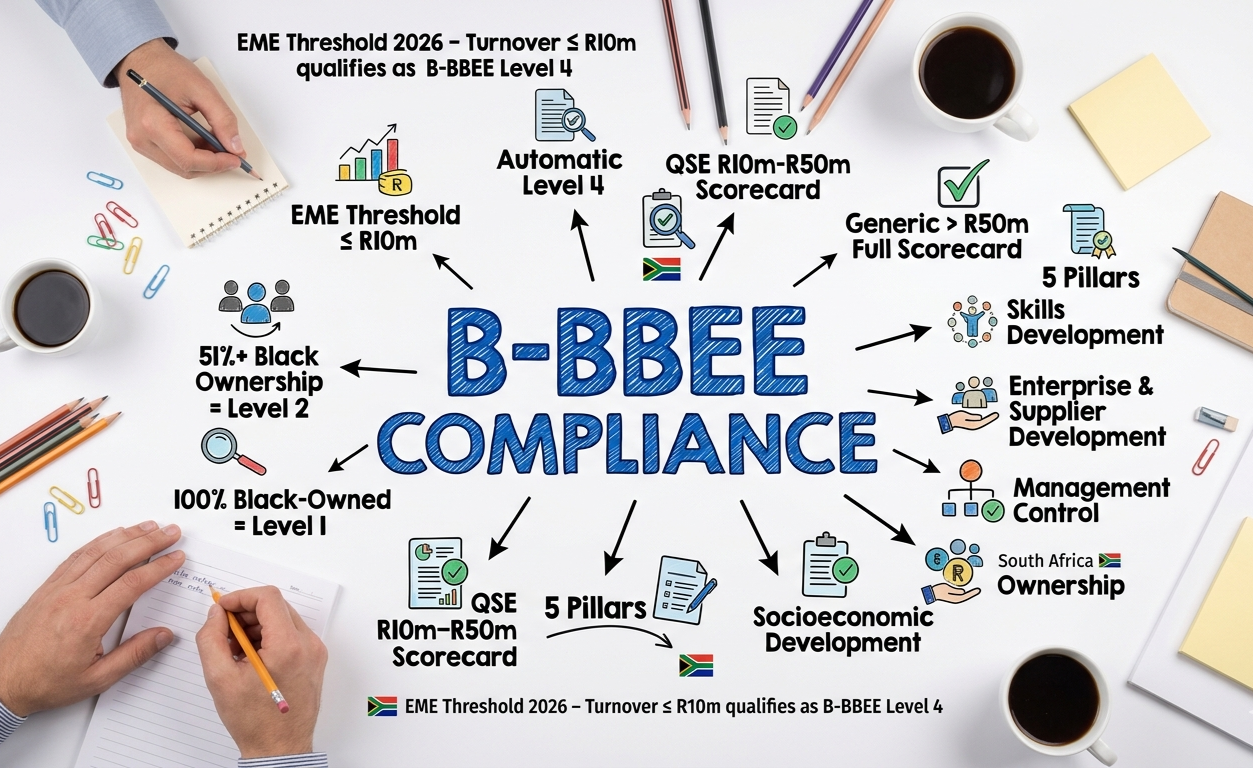
Your annual turnover determines your B-BBEE classification - EME, QSE, or Generic enterprise.
EME Automatic B-BBEE Levels
If your annual turnover is R10 million or less, your B-BBEE level is determined by ownership - and only by ownership. You do not complete a scorecard. The levels are:
| Ownership | Automatic B-BBEE Level |
|---|---|
| Less than 51% black-owned | Level 4 |
| 51% or more black-owned | Level 2 |
| 100% black-owned | Level 1 |
EME self-certification (≤R5m)
A sworn affidavit confirming your turnover and ownership percentage is sufficient. No third-party verifier required. This is a significant cost saving introduced by the DTI for micro-businesses.
EME with accredited agency (R5m–R10m)
Businesses with turnover between R5 million and R10 million must use a SANAS-accredited verification agency. Cost is typically R8,000–R15,000 per year.
QSE Scorecard: How It Works for R10m–R50m Businesses
If your turnover is between R10 million and R50 million, you fall under the QSE category. Under the Amended Codes of Good Practice, QSEs are measured on all 5 pillars- the same elements as the Generic Scorecard. A 40% sub-minimum applies to two priority elements: Ownership (compulsory) and either Skills Development or Enterprise & Supplier Development.
| Pillar | Base Points | Bonus Points |
|---|---|---|
| Ownership | 25 | 4 |
| Management Control | 19 | 2 |
| Skills Development | 20 | 5 |
| Enterprise & Supplier Development | 40 | 4 |
| Socioeconomic Development | 5 | - |
| Total | 109 | 15 |
QSE exception for majority black-owned businesses
If your QSE is 51% or more black-owned, you qualify for automatic Level 2 via sworn affidavit - no full scorecard verification required. If 100% black-owned, you qualify as Level 1 via affidavit. This is the same affidavit route as EMEs.
Failing to meet the 40% sub-minimum on Ownership or your chosen second priority element results in your overall score being discounted by one level - even if your total points qualify you for a higher level.
Generic Scorecard: Full 5-Pillar Breakdown for R50m+ Businesses
For businesses with annual turnover exceeding R50 million, the full Generic Scorecard applies. All 5 pillars are measured and the maximum achievable total is 124 points - 109 base points across the 5 pillars plus 15 bonus points available under Ownership, Management Control, Skills Development, and ESD.
| Pillar | Weighting Points | Bonus Points | Total Available |
|---|---|---|---|
| Ownership | 25 | 4 | 29 |
| Management Control | 19 | 2 | 21 |
| Skills Development | 20 | 5 | 25 |
| Enterprise & Supplier Development | 40 | 4 | 44 |
| Socioeconomic Development | 5 | - | 5 |
| Total | 109 | 15 | 124 |
B-BBEE Levels and What They Mean for Your Business
Your B-BBEE level determines how much of your spend counts toward government and corporate procurement targets. A Level 4 supplier contributes 100% of invoice value toward the buyer's scorecard. A non-compliant supplier contributes nothing.
| Score (Generic) | Level | Recognition % |
|---|---|---|
| ≥ 100 points | Level 1 | 135% |
| ≥ 95 but < 100 | Level 2 | 125% |
| ≥ 90 but < 95 | Level 3 | 110% |
| ≥ 80 but < 90 | Level 4 | 100% |
| ≥ 75 but < 80 | Level 5 | 80% |
| ≥ 70 but < 75 | Level 6 | 60% |
| ≥ 55 but < 70 | Level 7 | 50% |
| ≥ 40 but < 55 | Level 8 | 10% |
| < 40 points | Non-compliant | 0% |
Recognition % explained: When you are a supplier to a large company applying for B-BBEE points under their ESD pillar, this multiplier applies to your invoice value. A Level 1 supplier's spend counts at 135%, meaning R1m spent counts as R1.35m on their scorecard. Level 4 counts at 100% - still fully qualifying. Non-compliant counts as R0.
Level 4 is the minimum for government contracts
Government procurement above R30,000 requires B-BBEE compliance. Tenders above R500,000 typically require Level 4 or better. Being Non-Compliant disqualifies you from all government work until you obtain a valid certificate.
How to Improve Your B-BBEE Level
For most SA SMEs, the fastest ways to move up a level focus on the pillars with the highest points-to-effort ratio:
1. Skills Development - highest points per rand spent
Spending 1% of your payroll on qualifying training for black employees (registered with a SETA) can add 6–8 points. Formal documentation of all training - course name, provider, date, learner name, race - is required. Claim SETA levy refunds as part of the process.
2. Enterprise & Supplier Development - biggest pillar
Audit your supplier base. Where possible, shift spend to black-owned, Level 1–3 suppliers. Even shifting 20% of your top-20 supplier spend can materially move your score. Request B-BBEE certificates from all suppliers to track contributions accurately.
3. QSE priority elements - focus on the two that matter most
QSEs must meet a 40% sub-minimum on Ownership (compulsory) and one other priority element - Skills Development or ESD. Exceeding the sub-minimum on your second priority element boosts your score on the pillar with the highest available points. If ownership is low, channel effort into Skills Development or ESD to maximise your 40+ point pillars.
4. Socioeconomic Development - easiest 5 points
1% of Net Profit After Tax donated to a qualifying NPO with 75%+ black beneficiaries. Keep receipts, confirm the NPO qualifies, and document year-end. This is the easiest B-BBEE investment available.
Risk: Misrepresenting B-BBEE status is a criminal offence
Under the B-BBEE Act, fronting and misrepresentation carry fines of up to 10% of annual turnover or 10 years imprisonment. Using an outdated affidavit or inaccurate scorecard when bidding for contracts also constitutes grounds for blacklisting from government procurement.
B-BBEE scoring is data-driven. Your HR data is the input.
Synthro tracks management demographics, training spend, and Employment Equity data automatically. At year-end, your B-BBEE verifier gets clean, categorised input data - not a box of payslips.
What Counts as B-BBEE Fronting - and Why It Carries Criminal Penalties
Fronting is defined under the B-BBEE Act as any transaction, arrangement, or conduct that misrepresents the true B-BBEE ownership or control of a business. It is not limited to elaborate schemes. It includes practical everyday situations: a business that lists a black director or shareholder who has no genuine economic participation, a firm that inflates training spend claimed on a scorecard, or an EME that submits a sworn affidavit with an inaccurate ownership percentage.
The penalties under Section 10 of the B-BBEE Act are significant. A person found guilty of misrepresenting B-BBEE compliance faces a fine of up to 10% of annual turnover or up to 10 years imprisonment. Businesses found guilty may be debarred from government procurement for periods of five to ten years, effectively excluding them from the state supply chain for that period. The Department of Trade, Industry, and Competition has increased enforcement activity since 2020, with prosecutions spanning the construction, financial services, and professional services sectors.
For SMEs that qualify as EMEs or QSEs, the fronting risk most commonly arises from inaccurate affidavits and expired certificates used in tender submissions. Using a B-BBEE certificate or affidavit that has been superseded by a change in the business's ownership structure - even if the change was minor - constitutes misrepresentation. Certificates are valid for exactly twelve months from date of issue or affidavit signing. After that date, the document is expired and cannot lawfully be submitted for any compliance purpose.
Step-by-Step: How to Get Your EME B-BBEE Certificate
For businesses with annual turnover under R5 million, the process requires no third-party verification. You complete a sworn affidavit before a commissioner of oaths, confirming your annual turnover figure and the exact percentage of the business that is black-owned. The affidavit template is published by the DTIC and is widely available from verification agencies and industry bodies. Once sworn, this affidavit serves as your B-BBEE compliance certificate for a period of twelve months.
For businesses with turnover between R5 million and R10 million, the same affidavit route is available but must be completed before a SANAS-accredited verification agency rather than any commissioner of oaths. The cost is typically R5,000 to R10,000 per year. For businesses with turnover between R10 million and R50 million, the full QSE scorecard verification applies and requires a SANAS-accredited agency to review documentation across all five pillars, typically taking two to four weeks and costing R15,000 to R35,000 annually.
Begin collecting your supporting documentation at least two months before your target certificate date. For ownership verification you will need your share register, shareholders agreement, and identity documents for all black shareholders. For Skills Development you need all training invoices, SETA registration details, and learner demographic information. For ESD you need B-BBEE certificates from your top suppliers and a full procurement spend analysis. For Socioeconomic Development you need receipts and confirmation of qualifying status for any NPO donations made in the period. Clean, complete documentation reduces verification time and the risk of points being disallowed.
Annual verification dates should be calendared twelve months in advance and scheduled to run at least two months before your largest procurement deadline. B-BBEE compliance that lapses between verification cycles costs significantly more to recover than it would have cost to maintain. A lapsed certificate at the point of a major tender submission is not a minor administrative issue - it is a disqualifying event that cannot be remedied in the time available.
Frequently Asked Questions
Do I need a B-BBEE certificate if I am a sole proprietor?
Sole proprietors with turnover under R10 million are EMEs and qualify for automatic Level 4. If 100% black-owned, you qualify as Level 2. You can self-certify using a sworn affidavit. No third-party verifier is needed below R5 million turnover.
Can I improve my B-BBEE level without changing ownership?
Yes. Ownership is one of 5 pillars, but you must still meet the 40% sub-minimum on the Ownership element. Beyond the sub-minimum, a QSE can significantly improve its level by maximising Skills Development, ESD, Management Control, and SED. Many SMEs improve by 2–4 levels through documented training spend, supplier shifts, and management representation changes.
How much does B-BBEE verification cost for a QSE?
SANAS-accredited verification for a QSE typically costs R15,000–R35,000 per year depending on complexity. EMEs up to R5 million can self-certify at no cost using a sworn affidavit.
How long is a B-BBEE certificate valid?
A B-BBEE verification certificate is valid for 12 months. You must be re-verified annually. EMEs under R5 million can renew their affidavit themselves each year at no cost.
Related Guides
BCEA Leave Guide: All Leave Types Calculated
14 min
How to Avoid a CCMA Case (2026 Guide)
16 min
B-BBEE Scorecard Guide for South African SMEs
12 min