What Is B-BBEE and Why Does It Matter for Your Business?
Broad-Based Black Economic Empowerment (B-BBEE) is a South African government policy framework governed by the B-BBEE Act 53 of 2003 and the Broad-Based Black Economic Empowerment Act Amendment Act 46 of 2013. It measures the degree to which a business contributes to the economic transformation and empowerment of black South Africans.
The B-BBEE scorecard gives you a level from 1 (best) to 8 (worst), plus "Non-Compliant" if you don't meet minimum thresholds. This level directly affects:
Importantly, B-BBEE is not just for large companies. Government has specific "simplified scorecards" for smaller businesses (EME and QSE) that are far less complex and much easier to implement than the full Generic scorecard.
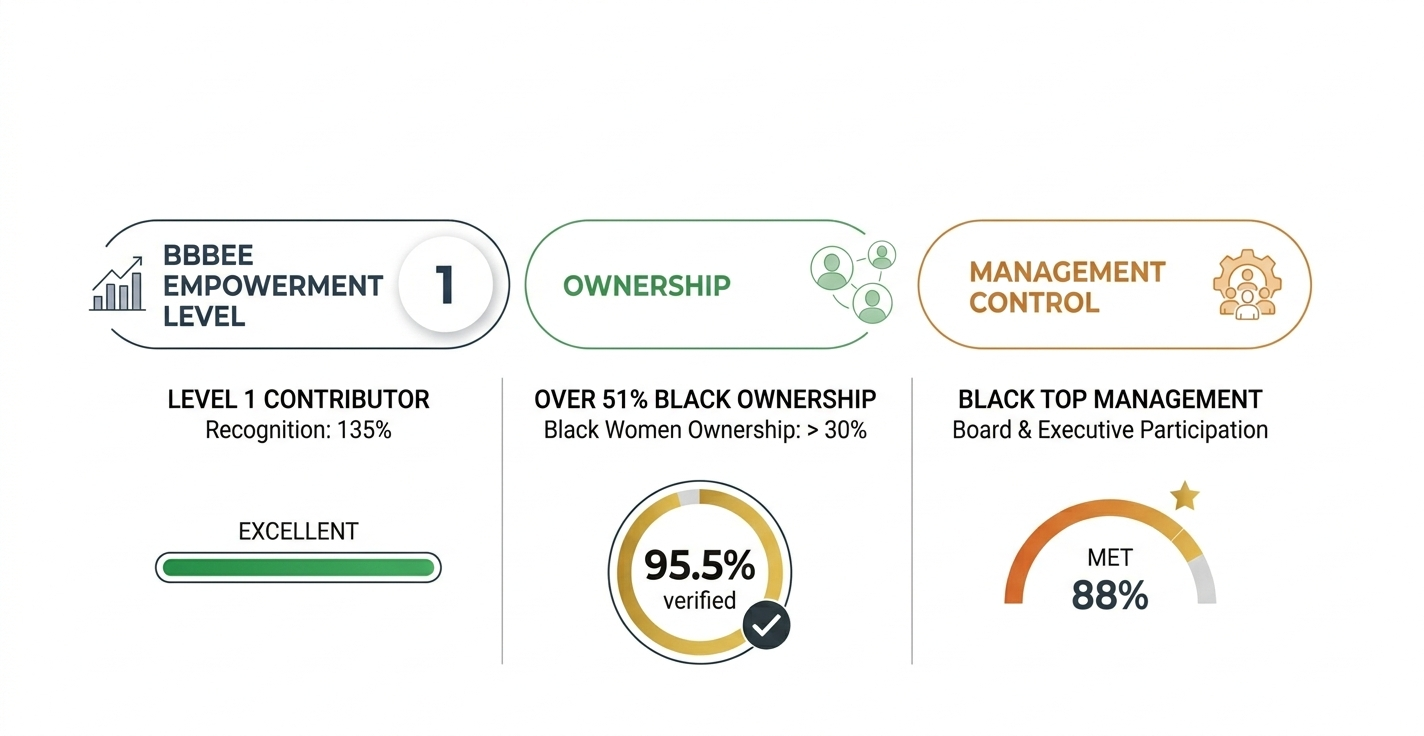
B-BBEE compliance determines whether you win or lose government and corporate tenders in South Africa.
EME, QSE, or Generic Enterprise: Which One Are You?
Your classification is determined by your Annual Turnover (the total revenue your business generates per year). This determines how many pillars you need to measure and how complex your scorecard is.
EME (Exempt Micro Enterprise)
SimplestThreshold: Annual turnover ≤ R10 million
Level: Automatic Level 4 (or Level 2 if ≥51% black-owned, Level 1 if ≥51% black women-owned)
Pillars: No scorecard required
Verification: Self-certify via sworn affidavit (≤R5m). Accredited agency required (R5m–R10m).
QSE (Qualifying Small Enterprise)
ModerateThreshold: Annual turnover R10m – R50m
Level: Measured scorecard (all 5 pillars - Amended Codes 2015)
Pillars: All 5 required: Ownership, Management Control, Skills Development, Enterprise & Supplier Development, Socio-Economic Development. 40% sub-minimum applies to Ownership + one other priority element.
Verification: SANAS-accredited B-BBEE verification agency required annually.
Generic Enterprise
ComplexThreshold: Annual turnover > R50 million
Level: Full 5-pillar scorecard (105 weighted points)
Pillars: All 5 pillars measured in full. Priority elements apply (Ownership, Skills, ESD).
Verification: Full SANAS-accredited verification annually. Complex and costly.
EME Tip for Black-Owned Businesses
If your business is ≥51% black-owned and your turnover is under R10 million, you automatically qualify as B-BBEE Level 2 without completing any scorecard. This gives you significant tender preference at a very low compliance cost.
How Much Does a B-BBEE Certificate Cost?
It depends entirely on which route your business qualifies for. There are two paths, and one of them is free:
EME (turnover under R10 million) - Free
You self-certify with a sworn affidavit - no accredited verifier, no fee. This is the route almost every small SA business qualifies for, and it's the same automatic Level 4 (or Level 2 if 51%+ black-owned) covered above.
QSE / Generic (turnover over R10 million) - R15,000-R35,000/year
A SANAS-accredited verification agency issues the certificate after a site visit and document review. Price scales with company complexity - more entities, more procurement data, and more pillars measured all raise the fee. The certificate is valid for 12 months, so this is an annual cost.
Current scorecard
Level 4
66.7 points · 100% procurement recognition
Points by pillar
5.6 points from Level 3. Closing the skills-development spend gap does it. Tracked live, not at audit.
The 5 Scorecard Pillars Explained
The Generic B-BBEE scorecard has 105 points spread across 5 pillars. Here's what each pillar measures, the maximum weighting, and the key compliance actions for SMEs.
Ownership
25 pointsPriority ElementThe percentage of economic interest and voting rights held by black people in your business.
Management Control
19 pointsThe representation of black people in senior and middle management, and on the board of directors. Based on headcount ratios.
Skills Development
20 pointsPriority ElementTraining and skills spend as a percentage of your leviable payroll, specifically for black employees and black disabled employees.
Enterprise & Supplier Development (ESD)
40 pointsPriority ElementHow much you spend with black-owned and black women-owned suppliers within your supply chain. Also includes enterprise development spend (loans, grants, mentoring).
Socio-Economic Development (SED)
5 pointsContributions to socio-economic development or community development initiatives that benefit black beneficiaries.
B-BBEE Points Table: Levels and What They Mean
| Level | Points Required | Recognition % | Procurement Weight |
|---|---|---|---|
| Level 1 | 100+ | 135% | Maximum (most preferred) |
| Level 2 | 95–99 | 125% | Very strong preference |
| Level 3 | 90–94 | 110% | Strong preference |
| Level 4 | 80–89 | 100% | Minimum for most tenders |
| Level 5 | 75–79 | 80% | Disadvantaged, avoid for tenders |
| Level 6 | 70–74 | 60% | Weak tender position |
| Level 7 | 55–69 | 50% | Very weak tender position |
| Level 8 | 40–54 | 10% | Near-disqualified |
| Non-Compliant | <40 | 0% | Disqualified from government tenders |
Note on Recognition %: This multiplier is used when you are a supplier to a large company applying for B-BBEE points for their ESD pillar. Level 1 suppliers give them 135% recognition, meaning their spend counts for more. This is why corporates actively seek Level 1–3 suppliers.
The Real Cost of a Bad B-BBEE Level
Disqualified from government tenders
High impactNon-Compliant entities cannot supply to national, provincial, or local government. Under the PPPFA (Preferential Procurement Policy Framework Act), B-BBEE compliance above Level 4 is required for tenders above R500k. Level 5 and below often lose to Level 4+ competitors, even with a lower price.
Locked out of corporate supply chains
High impactJSE-listed companies and large multinationals measure their own ESD (Enterprise & Supplier Development) scores. Non-compliant or low-level suppliers hurt their score. The practical result: preferred supplier lists require Level 4+.
Clients buy less from you (ESD impact)
Medium impactWhen a corporate spends R1m with a Level 1 supplier, it counts as R1.35m on their scorecard. When they spend R1m with a Non-Compliant supplier, it counts as R0. So even if you win the work, they prefer to place orders with better-rated suppliers.
Grant and funding ineligibility
Medium impactSEDA, IDC, NEF, NYDA, and most government-backed funds require a valid B-BBEE certificate. Companies below Level 4 often cannot access business funding programmes, skills grants, and incentive schemes.
How to Improve Your B-BBEE Score: Practical Steps for SMEs
Most SMEs can move two entire B-BBEE levels in 12–18 months with the right focus. Here's what moves the needle most for QSEs:
1. Get your ESD (Supplier Development) spending right
This is the biggest pillar. Audit your supplier base immediately. Request B-BBEE certificates from your top 20 suppliers. Where possible, shift spend to black-owned, compliant suppliers. Even shifting 20% of your spend can swing your score dramatically.
2. Formalise your training spend and documentation
Many SMEs spend on training informally with no records. Start by documenting all training: course name, provider, date, learner name + race, cost. Claim all qualifying training against your leviable payroll. Register for SETA claims.
3. Review ownership structure
Even moving from 0% to 26% black ownership can dramatically change your level. Consult a B-BBEE specialist about employee share schemes, BEE trusts, or bringing in black shareholders. This is a long-term structural decision.
4. Contribute to a qualifying NPO (SED)
The easiest 5 points in B-BBEE. 1% of Net Profit After Tax to a qualifying NPO with >75% black beneficiaries. Keep receipts, confirm the NPO's qualifying status, and document. Done.
5. Track management demographics monthly
Your EEA2 report (Employment Equity) is the input to this pillar. If you're not filing EEA2 and tracking management headcount by race and gender, you're leaving points on the table and risking non-compliance penalties.
B-BBEE scoring is data-driven. Your HR data is the input.
Synthro tracks management demographics, training spend, and Employment Equity data automatically. At year-end, your B-BBEE verifier gets clean, categorised input data rather than a box of payslips.
What Counts as B-BBEE Fronting - and Why It Carries Criminal Penalties
Fronting is defined under the B-BBEE Act as any transaction, arrangement, or conduct that misrepresents the true ownership or control of a business for B-BBEE purposes. The concept covers a wide range of practices that SA small businesses sometimes adopt under commercial pressure - and the consequences are severe.
The most common forms of fronting that the Department of Trade, Industry, and Competition investigates include nominee ownership arrangements where a black person is listed as a shareholder but has no real economic rights or genuine involvement in the management of the business; passive black ownership where ownership has been transferred but the black shareholders have no meaningful decision-making power and no genuine economic participation; and misrepresentation of training expenditure or supplier development spend on scorecards - claiming costs that were never incurred or inflating values to reach a higher level.
Under Section 10 of the B-BBEE Act, any person found guilty of knowingly misrepresenting B-BBEE compliance can be fined up to 10% of annual turnover or sentenced to up to 10 years imprisonment. These are not theoretical penalties. The DTIC and National Prosecuting Authority have intensified enforcement since 2020, with multiple prosecutions in construction, mining, and professional services resulting in debarment from state contracts for periods of five to ten years.
For businesses that don't intend to front but simply haven't verified their scorecard data carefully, the risk is equally real. Using an outdated B-BBEE certificate, overclaiming training invoices as qualifying spend, or submitting an affidavit with inflated ownership percentages constitutes misrepresentation regardless of intent. The DTIC does not require evidence of deliberate fraud to issue a compliance notice and initiate enforcement proceedings.
How to Get Your B-BBEE Certificate: Step by Step
For an EME or QSE, the certification process is more straightforward than many SME owners expect. Start by determining your turnover category - EME under R10 million, QSE between R10 million and R50 million, or Generic above R50 million. EMEs with turnover under R5 million can self-certify using a sworn affidavit completed before a commissioner of oaths. The affidavit must confirm your turnover and the exact black ownership percentage. No third-party verifier is needed, and there is no cost beyond the commissioner's fee.
EMEs with turnover between R5 million and R10 million, and all QSEs, must use a SANAS-accredited verification agency. Start collecting your documentary evidence at least three months before your desired certificate date: audited or reviewed annual financial statements (or management accounts), a share register reflecting the current ownership structure, all training invoices and learner evidence from the past 12 months, supplier invoices with B-BBEE certificates attached for your top-20 suppliers, and your EEA2 Employment Equity report signed and submitted to the Department of Labour.
Once your documentation is in order, engage a SANAS-accredited BEE verification agency. The process typically takes two to four weeks from submission to certificate issue. B-BBEE certificates are valid for 12 months. Plan your annual verification cycle to run from approximately two months before your largest tender or contract renewal date, so your certificate is current when it matters most.
For QSEs specifically, the verification agency will request a board resolution or shareholder approval confirming that ownership percentages match the share register. Where discrepancies exist between company registration documents and the current share register, resolve those discrepancies before engaging the verifier. Certificate delays caused by ownership structure queries are the most common source of last-minute tender disqualifications in the South African public sector procurement environment. Building the habit of checking your ownership documentation every twelve months, not just when a tender arises, prevents the scramble that costs businesses contracts they were otherwise qualified to win.
The documentation you compile during annual verification also serves a secondary purpose: it demonstrates to procurement panels, clients, and government departments that your B-BBEE compliance is genuine and verifiable rather than merely asserted. In an environment where enforcement is actively intensifying and front companies are being identified across multiple sectors, verified and well-maintained documentation distinguishes businesses that are genuinely compliant from those that only appear to be.
Frequently Asked Questions
Do I need a B-BBEE certificate if I'm a sole proprietor?
Sole proprietors under R10 million turnover are EMEs and qualify for automatic Level 4. If you're 100% black-owned, you qualify as Level 2. You can self-certify using a sworn affidavit. No third-party verifier needed below R5 million turnover.
Can I improve my B-BBEE level without changing ownership?
Yes. Ownership is one of 5 pillars. A QSE measuring 4 pillars can achieve Level 3 by maximising Skills Development, ESD, Management Control, and SED, without any change to ownership. Many SMEs improve by 2–4 levels purely through documentation and supplier management.
How much does a B-BBEE certificate cost for a QSE?
SANAS-accredited verification for a QSE typically costs R15,000–R35,000 per year depending on complexity. This includes the site visit, document review, and certificate issuance. EMEs up to R5 million can self-certify at no cost.
What happens if I submit false information to get a better B-BBEE score?
Under the B-BBEE Act, fronting is a criminal offence. Penalties include fines, debarment from government contracts for up to 10 years, and imprisonment. The DTI has intensified enforcement. Always use an accredited verifier and submit accurate data.
Related Guides
BCEA Leave Guide: All Leave Types Calculated
14 min
How to Avoid a CCMA Case (2026 Guide)
16 min
Complete Employee Onboarding Guide for SA
11 min