The Act sets the floor. The policy decides the rest.
A leave policy in South Africa does two jobs. It restates the minimums in Chapter Three of the BCEA (annual leave in section 20, sick leave in section 22, family responsibility leave in section 27, parental leave as it now stands) so nobody falls below them by accident. And it writes down every decision the Act leaves to you: how far ahead to apply, whether the business closes in December, what happens to unused days, when a sick note is needed.
The second job is the one that matters. A minimum is a minimum whether or not you write it down. A choice you never wrote down is made for you, case by case, by whatever the last manager did. The free template below prints the minimums as fixed text and leaves every choice in brackets.
The part that gets tested later
A leave policy is read most closely in a dispute about leave somebody lost. Think of the last time unused leave was forfeited in your business. Could you show the written rule it was forfeited under?
The Act is the floor. This is the rest.
Editable Word (.docx) and print-ready PDF. Annual, sick, family responsibility and parental leave, each tied to its BCEA section; the six policy choices in brackets; an acknowledgement page for every personnel file.
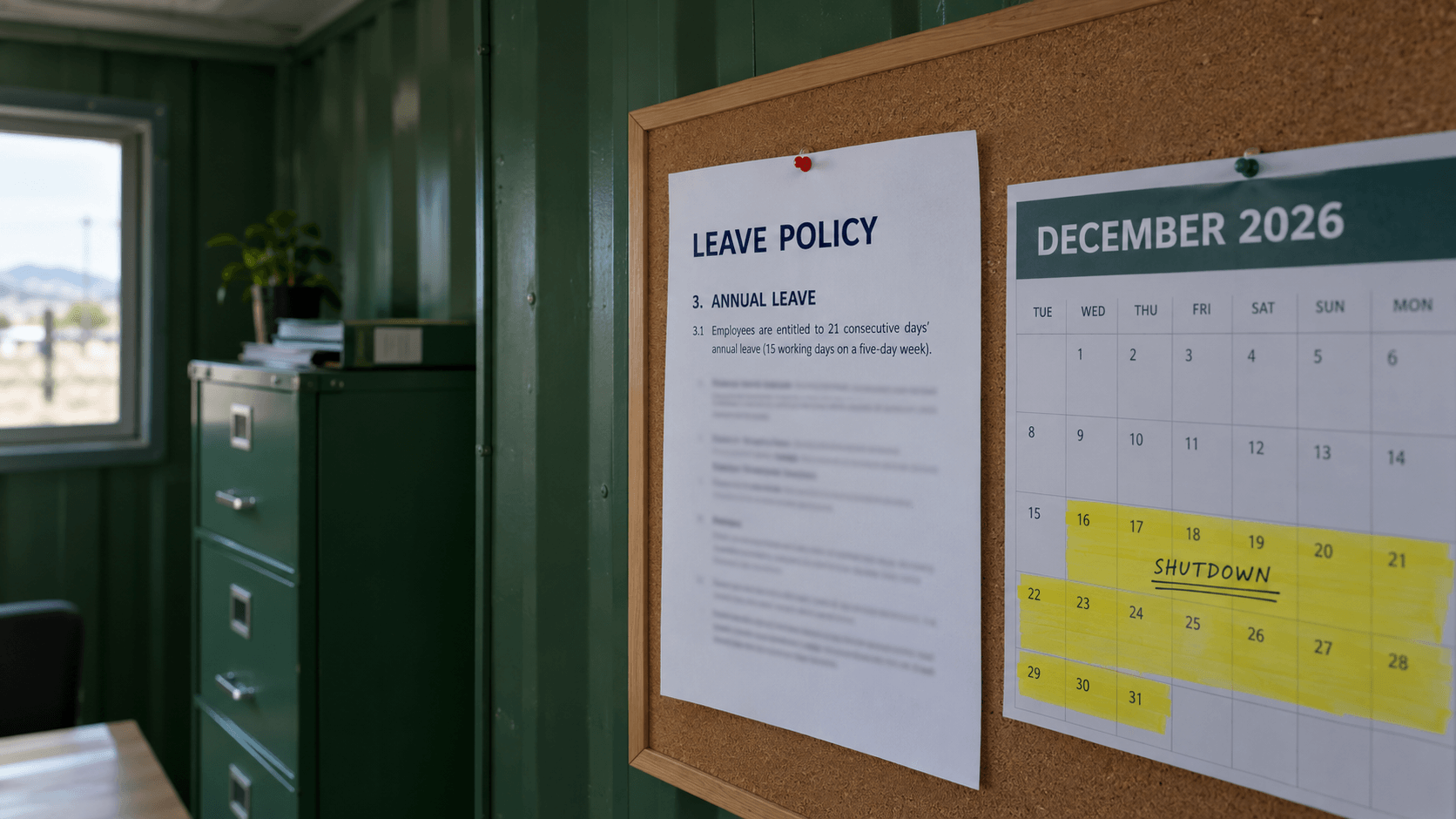
The December shutdown rule belongs in the policy, not in a December email.
Leave entitlement in South Africa, by section
- Annual leave (s20). 21 consecutive days per 12-month cycle: 15 working days on a five-day week, 18 on a six-day week. Or, by agreement, one day per 17 days worked. Granted within six months of the end of the cycle.
- Sick leave (s22, s23). The days the employee would work in six weeks, per 36-month cycle: 30 on a five-day week. One day per 26 worked in the first six months. Run the cycle with the sick leave calculator.
- Family responsibility leave (s27). Three paid days per annual cycle for a sick child or a death in the close family, after four months, for staff working four or more days a week. The details are in the family responsibility leave guide.
- Parental leave. Since the Constitutional Court’s Van Wyk judgment (3 October 2025), parents share a pool of four months plus ten days. Unpaid by the employer unless you choose otherwise; claimed from the UIF. See the parental leave guide.
Who the leave chapter covers - BCEA s19(1)
works 24 hours a month or more → Chapter Three applies · fewer → it does not
Two more rules belong in every policy because they decide disputes: a public holiday that falls on a working day during annual leave earns an extra day of leave (section 20(8)), and annual leave may not run during a notice period or any other statutory leave (section 20(5)).
The six choices a leave policy has to make
1. How far ahead to apply
The Act is silent. Ten working days for longer leave and two for a single day is common. Put it in writing, then apply it consistently: the rule is only as strong as the most generous exception.
2. The December shutdown
Failing agreement, the employer decides when annual leave is taken (section 20(10)), so a policy may apply annual leave to a year-end closure. It can only use leave the employee has actually accrued. A new starter with four days of leave and a three-week closure needs a decision about the other days, and that decision belongs in the policy, not in a December email.
Worked example: a closure from 16 December 2026 to 2 January 2027, five-day week
| Working days in the closure | weekdays, Wed 16 Dec to Fri 1 Jan | 13 days |
| Public holidays on working days | 16 Dec, 25 Dec, 1 Jan (26 Dec is a Saturday) | 3 days |
| Annual leave needed | 13 - 3, since s20(8) adds a day per holiday | 10 days |
| New starter has accrued | about 1.25 days a month for 4 months | 5 days |
| Gap the policy must decide | unpaid, paid special leave, or leave in advance | 5 days |
Leave in advance is the option that causes trouble later: if the employee leaves before earning it back, it can only be recovered from final pay with a written agreement signed at the time (section 34). Say in the policy which option you use, and the December email writes itself.
3. Carry-over and forfeiture
Statutory leave must be granted within six months after the cycle ends (section 20(4)). The Act does not say what happens next, which is why this is the most disputed clause in any policy. The position that holds up: statutory leave is forfeited only where the employee was offered it and chose not to take it, recorded in writing. Leave above the minimum is different. Section 19(2) leaves it to your agreement, so you can cap it, carry it or forfeit it as you choose.
4. When a sick note is needed
Section 23 lets you withhold sick pay for want of a certificate only where the absence runs for more than two consecutive days, or is the third occasion in eight weeks. A policy asking for a note after every Monday off is common. Refusing to pay for one undocumented Monday outside that rule is not lawful.
5. Unpaid and special leave
Discretionary, so it needs a written rule: who approves it, how many days, and that it is approved before it is taken. Study leave, religious observance and compassionate leave for an in-law’s funeral all belong here.
6. What counts as absence without leave
The day count that starts the process, who phones whom, and the written instruction to return. Without it, a run of unexplained days has no procedure behind it, which is how a simple absence becomes an abscondment dispute.
Can employees sell leave days?
Not their statutory minimum, while they remain employed. Section 20(11) allows payment instead of annual leave only on termination, and section 20(9) forbids an employer to require or permit work during annual leave. The point of the minimum is rest, and the Act will not let it be bought out.
Leave above the minimum is a contractual benefit, and section 19(2) leaves its terms to you. A policy can lawfully let employees cash in enhanced days, at a rate it states. When employment ends, all accrued annual leave is paid out in full, whatever the reason for leaving: the leave payout calculator shows the working.
How to introduce a leave policy without starting a dispute
A first leave policy usually writes down what the business already does. That part is easy. The trouble starts where the policy is stricter than the habit it replaces: a carry-over that used to be unlimited and is now capped, a December closure that used to be paid and is now annual leave, a sick-note rule nobody enforced before.
- Separate the minimums from the benefits. Bringing the policy up to the BCEA needs nobody’s agreement. Taking away a benefit employees already have, by contract or by long, consistent practice, is a change to their terms and conditions, and that needs agreement, not an announcement.
- Give notice and a start date. A policy that applies from the first day of the next leave cycle, announced a month ahead, gives everyone time to take or plan the days a new carry-over cap would affect.
- Get it signed. The template ends with an acknowledgement page. A policy you cannot show an employee received is a policy you will struggle to enforce against them.
- Check what overrides it. A bargaining council agreement or a sectoral determination wins where it is more favourable. Domestic workers, for example, get five days of family responsibility leave under Sectoral Determination 7, not three, and their contract is covered by the domestic worker contract template.
Then keep the balances somewhere everyone trusts. A policy creates entitlements; the leave tracker or your HR system is what proves each one was honoured, and every request should arrive on the same leave application form.
Five leave policy mistakes that end up at the CCMA
A forfeiture rule that forfeits leave you refused
If the employee asked and you said no, the leave was not declined.
A sick-note rule stricter than section 23
Asking for a note is fine. Docking pay for one undocumented day outside the two-day and eight-week rule is not.
Family responsibility leave for a birth
Removed in 2018. Births are parental leave now.
A shutdown that spends leave not yet earned
Recovering the advance from final pay needs a written agreement signed at the time (section 34).
A policy nobody signed
Have each employee acknowledge it, and keep leave records for three years (section 31).
A policy is a promise to apply the same rule twice.
The document is the easy part. Applying it is where it fails: one manager approves a shutdown exception another refused, a balance is updated in one spreadsheet and not the other, a forfeiture runs against leave somebody asked for. Synthro turns the policy into leave rules, so every request is checked against the same cycle, balance and notice period before anyone approves it.
Frequently Asked Questions
Is a leave policy compulsory in South Africa?
The BCEA does not require a separate leave policy, but section 29 requires the written particulars of employment to state the employee’s leave, and every choice the Act leaves open (notice to apply, shutdowns, carry-over) is unenforceable unless it is written down somewhere. A policy is where those choices live.
How many leave days per year in South Africa?
At least 21 consecutive days of paid annual leave per 12-month cycle, which is 15 working days on a five-day week and 18 on a six-day week (BCEA section 20). By agreement it can accrue at one day for every 17 days worked instead. An employer may give more, never less.
Can an employer force employees to take leave in December?
Yes, within limits. Annual leave is taken at a time agreed with the employee, and failing agreement at a time the employer determines (section 20(10)). A policy that applies annual leave to a December shutdown is lawful, but it can only use leave the employee has accrued, and a closure beyond that is unpaid or paid special leave.
Can leave days be sold or paid out in South Africa?
Statutory annual leave can only be paid out on termination of employment (section 20(11)). Paying an employee to work through their minimum leave while they stay employed is not permitted. Leave above the BCEA minimum is governed by the contract or policy (section 19(2)), so an enhanced-leave buy-back can be lawful if it is written down.
What happens to unused leave at the end of the year?
The employer must grant annual leave within six months after the end of the cycle it accrued in (section 20(4)). The Act does not spell out forfeiture, so the safe policy is that statutory leave is lost only where it was offered and the employee chose not to take it, in writing. Leave above the minimum can be forfeited on whatever terms the policy sets.
Can an employer refuse a leave request?
An employer can refuse the dates, not the entitlement. Timing is by agreement and, failing agreement, set by the employer, but the employer must still grant the full annual leave within six months of the end of the cycle. Refusing every proposed date until the leave lapses is not a lawful way to manage it.
Do part-time employees get leave in South Africa?
Yes, if they work 24 hours a month or more (section 19(1)). Part-time annual leave usually accrues at one day for every 17 days worked, or one hour for every 17 hours. Family responsibility leave is narrower: it needs at least four days of work a week.
How many sick days do employees get in South Africa?
The number of days the employee would normally work in six weeks, over a 36-month sick leave cycle: 30 days on a five-day week, 36 on a six-day week (BCEA section 22). In the first six months of employment, sick leave accrues at one day for every 26 days worked instead.
Do public holidays count as annual leave days?
No. If a public holiday falls on a day the employee would ordinarily have worked during their annual leave, they get an extra day of leave (section 20(8)). A December shutdown that spans Christmas Day and the Day of Goodwill therefore uses fewer annual leave days than the calendar suggests.
When can an employer ask for a sick note?
Section 23 lets an employer withhold sick pay without a medical certificate only where the employee is absent for more than two consecutive days, or on more than two occasions in an eight-week period. A policy can ask for a note sooner, but cannot refuse to pay for a single day outside that rule.