When you can ask for a sick note: the two-and-eight rule
Section 23 of the BCEA lets an employer refuse to pay sick leave without a medical certificate in two situations:
- The employee has been absent for more than two consecutive days.
- The employee has been absent on more than two occasions in an eight-week period.
BCEA s23(1)
3+ consecutive days or 3rd absence in 8 weeks → certificate required for sick pay
Outside those two triggers, a one-day or two-day absence is paid sick leave on the employee’s word, and it comes off the balance. How many days the balance holds is the sick leave calculator’s job: 30 days per 36-month cycle on a five-day week.
The rule only works with the dates
The third absence in eight weeks needs a certificate. Applying that rule needs the dates of the first two. Could you show today how many times one employee has been off sick in the last eight weeks?
A sick leave register that applies the two-and-eight rule for you
Free Excel register: one row per absence, and it counts the days used in each 36-month cycle and the absences in the last eight weeks, then flags the ones section 23 says need a certificate. The PDF is the paper version.
Page 1 of 1
- Excel
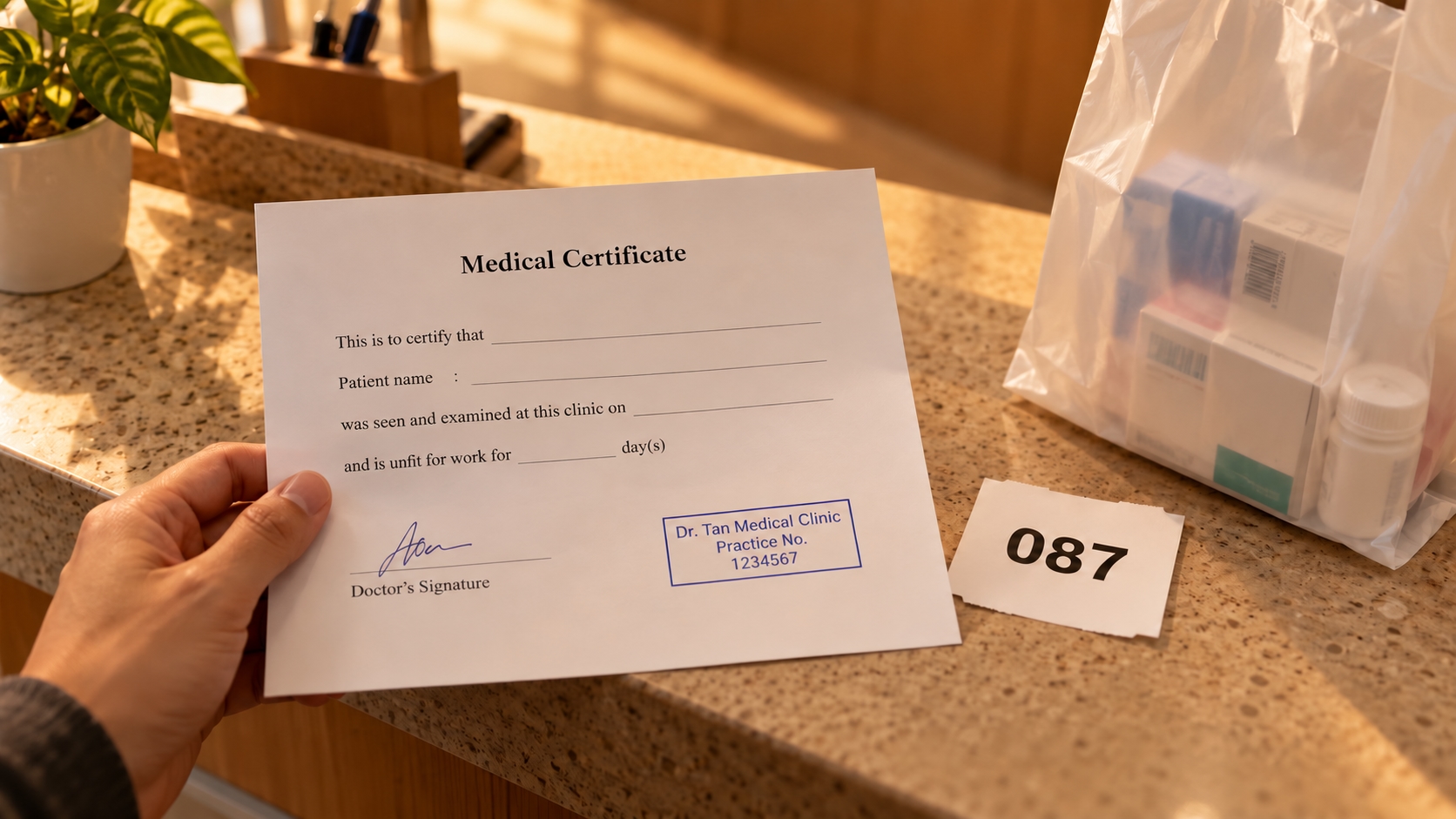
Check the practice number, the dates and the signature.
What makes a sick note valid
Section 23(2) requires the certificate to be issued and signed by a medical practitioner, or another person certified to diagnose and treat patients and registered with a professional council established by an Act of Parliament. In practice, check for:
- The practitioner’s name, qualification and practice or registration number
- The practice’s address and phone number
- The date of the consultation, which should fall in the period of absence
- A statement that the employee was unfit for work, and for which dates
- A signature
A note dated after the absence that says only “the patient reports being ill” is the practitioner recording what they were told, not a diagnosis. It is worth querying, politely, with the practice. Whether a note from a nurse, clinic sister or traditional health practitioner qualifies turns on the same test: are they certified to diagnose and registered with a council. Ask for the registration number.
Monday and Friday sick days
A pattern of single days next to weekends and public holidays is the most common sick leave complaint, and the eight-week rule is the tool section 23 gives you. The third short absence in eight weeks needs a certificate, however short.
Beyond that, a pattern is a conversation before it is a disciplinary matter. Repeated genuine illness may be an incapacity question, handled under the Code of Good Practice: Dismissal with a fair process, not as misconduct. Dishonesty, such as a note bought without a consultation, is misconduct and goes to a disciplinary hearing. Telling them apart starts with a leave record that shows the dates.
Four sick note cases, worked out
The two-and-eight rule applied to the absences people actually ask about.
Off on Monday, back Tuesday; off again the next Friday
Two occasions of one day each. No certificate can be required for either, and both are paid sick leave. The third occasion inside eight weeks of the first is the one that needs a note, however short.
Off Tuesday, Wednesday and Thursday
More than two consecutive days: a certificate may be required before the three days are paid (section 23(1)(a)). Without it, the days may be treated as unpaid.
Brings a note from a pharmacist
Section 23(2) requires a medical practitioner or someone certified to diagnose and treat and registered with a professional council. A pharmacist is not certified to diagnose, so the note does not meet the section; ask for one that does.
Three months into the job, off for four days with a certificate
In the first six months the entitlement is one day’s paid sick leave for every 26 days worked (about three days by month three). Three days paid, one unpaid or taken as annual leave by agreement.
Sick notes and POPIA
A sick note is health information, a special category of personal information under section 26 of POPIA. Employers may process it to administer sick leave and meet their obligations under labour law (section 32 allows this for employers), but should keep it on the employee’s file with limited access, not in a WhatsApp group or a shared inbox. Ask for the period of incapacity, not the diagnosis. The POPIA employer guide covers the rest.
Five sick note mistakes employers make
A note for every single day
Section 23 allows it only from the third absence in eight weeks, or after two days in a row.
Refusing a note from a registered practitioner
If it meets section 23(2), it must be accepted. Verify it if in doubt; do not just reject it.
Asking for the diagnosis
Health data under POPIA. Ask for the dates of incapacity.
Treating illness as misconduct
Genuine repeated illness is incapacity, with its own fair process.
No record of occasions
The eight-week rule cannot be applied without the dates of the last two absences.
The eight-week rule, counted for you
Section 23 turns on dates: how many days in a row, how many occasions in eight weeks. Synthro records each sick day against the employee’s 36-month cycle, flags the absence that needs a certificate, and stores the certificate on the request with access limited to the people who need it.
Frequently Asked Questions
When does an employee need a sick note in South Africa?
Under section 23 of the BCEA, when they are absent for more than two consecutive days, or when they have been absent on more than two occasions in an eight-week period. In either case the employer may refuse to pay sick leave without a medical certificate.
Can an employer ask for a sick note for one day off?
Only once the eight-week rule is triggered: on the third occasion of absence in eight weeks, even a single day needs a certificate. For a first or second one-day absence, section 23 does not let the employer withhold sick pay for want of a note, whatever the policy says.
Who can issue a valid sick note in South Africa?
A medical practitioner, or another person who is certified to diagnose and treat patients and registered with a professional council established by an Act of Parliament (BCEA section 23(2)). Check the practice or registration number on the certificate against the council’s register if you doubt it.
What must a sick note contain?
At minimum the practitioner’s name, qualification, practice or registration number and contact details, the date of the consultation, a statement that the employee was unfit for work, the period of absence, and a signature. The diagnosis is optional and may only be stated with the patient’s consent.
Can an employer refuse a sick note?
Yes, if it is not valid: it was not issued by a registered practitioner, it does not cover the dates, or it appears altered. The employer may verify the practitioner’s registration and confirm with the practice that the certificate was issued. A forged sick note is dishonesty and can justify dismissal after a fair hearing.
Do employees get paid sick leave without a sick note?
Yes, for absences that do not trigger section 23: one or two days, on no more than two occasions in eight weeks. Those days are paid and come off the sick leave balance. The sick leave calculator shows the balance across the 36-month cycle.