Is a 13th cheque compulsory? Only if you promised it
A 13th cheque is an extra month’s salary paid once a year, usually in November or December. No South African statute requires it. It becomes an obligation in one of three ways:
- The contract promises it.
- A bargaining council agreement that binds the business requires it, often with its own pro-rata and payment-date rules.
- Practice: it has been paid every year, to everyone, without any statement that it is discretionary, until employees reasonably expect it.
The test, in order
contract clause? → bargaining council agreement? → consistent practice? → if none of these, it is discretionary
The question that arrives in December
Every December someone asks why their bonus was taxed so much, and someone who left in October asks for theirs. Could you point both of them to the clause and the calculation that answers them?
Work out every 13th cheque and its PAYE in one sheet
Free Excel calculator: enter the salary and the completed months, get the pro-rata bonus, the PAYE on it from the 2026/27 tables and the amount after tax, for the whole payroll. The PDF shows the method with a worked example.
Page 1 of 1
- Excel
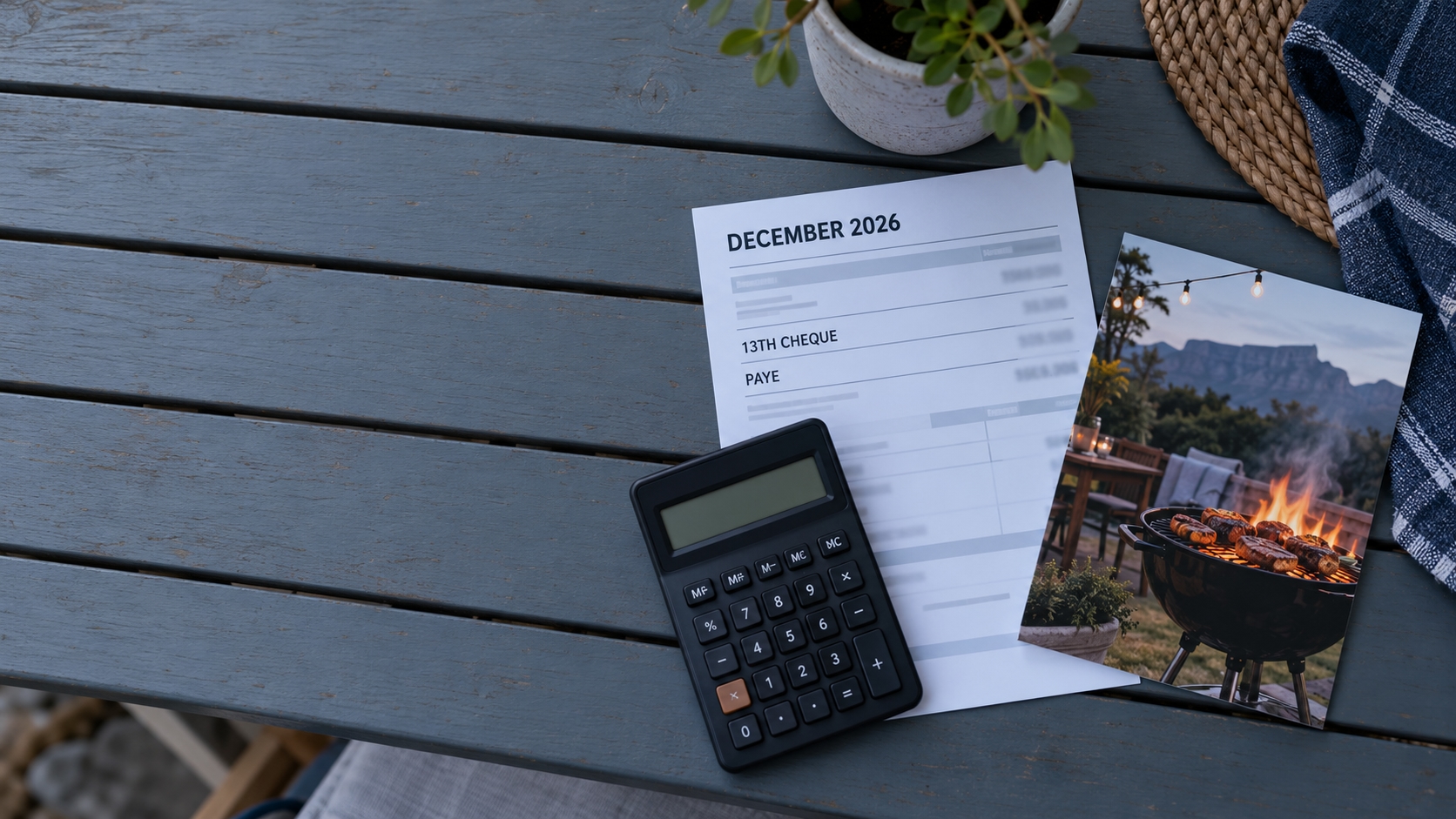
The December payslip: the bonus line and the PAYE that came with it.
How the 13th cheque is taxed: a worked example
SARS treats a 13th cheque as ordinary remuneration. Payroll taxes it at the employee’s marginal rate, by working out the tax on a full year with the bonus and subtracting the tax on the year without it.
PAYE on the bonus
tax on (annual salary + bonus) − tax on (annual salary)
Worked example: R15,000 a month, 13th cheque of R15,000, 2026/27 tax year
| Annual salary | R15,000 × 12 | R180,000 |
| With the bonus | R180,000 + R15,000 | R195,000 |
| Bracket | both under R245,100, so 18% | 18% |
| PAYE on the bonus | R15,000 × 18% | R2,700 |
| Bonus after PAYE | R15,000 − R2,700, before UIF | R12,300 |
At a higher salary the bonus can push income across a bracket, and the share taken rises. Some employers offer tax smoothing: the expected bonus is included in the monthly PAYE calculation all year, so December is not hit at once. Whatever the method, explain it on the payslip before the employee asks.
Pro rata: new starters, leavers and people on leave
The clause decides each of these, so it has to answer each of them:
Someone who started in June
A common rule is one-twelfth for each completed month. Seven months gives 7/12 of a month’s pay. Without a rule, the employee may argue for the full amount.
Someone who resigned in October
If the clause requires service on the payment date, nothing is owed. If it provides for pro rata, the amount belongs in the final pay run with the leave payout and notice.
Someone on maternity or parental leave
Decide in the policy whether leave months count towards the bonus, and apply it to everyone. A rule that reduces the bonus only for parental leave invites a discrimination claim.
Worked example: a pro-rata 13th cheque
Started 1 June 2026 on R15,000 a month; clause pays one-twelfth per completed month
| Completed months to 30 November | June to November | 6 |
| Full 13th cheque | one month’s basic salary | R15,000 |
| Pro-rata share | 6 ÷ 12 | 50% |
| Pro-rata 13th cheque | R15,000 × 6 ÷ 12 | R7,500 |
The same arithmetic applies to a leaver whose clause allows pro rata: count the completed months in the bonus year to the last working day. Unpaid leave is the only common reason to reduce the months, and only if the clause says so.
When a bargaining council sets the 13th cheque
In several sectors a bargaining council agreement extended to non-parties fixes the bonus for every employer in its scope, member or not. These agreements typically set three things: the amount (often 4.333 weeks’ pay, a month in the BCEA sense), the qualifying date (for example, in service on 1 December), and a pro-rata rule for shorter service.
If one binds you, it overrides a contract that offers less, and the council’s agents can enforce it. Check the council for your sector and area before December, not after a claim arrives. Restaurant and coffee shop owners in particular should check, because hospitality is covered differently in different regions; the restaurant labour law guide covers the rest.
Can an employer stop paying the 13th cheque?
A contractual or long-standing 13th cheque is a term of employment. Stopping it without agreement is a unilateral change, and an employee can challenge it as an unfair labour practice relating to benefits under section 186(2)(a) of the LRA, or claim the amount as a contractual debt.
If the business cannot afford it this year, the lawful routes are an agreed change after consultation, or a properly worded discretionary bonus going forward. If trading has fallen far enough that salaries are at risk too, the section 189 process sets out the consultation the law requires.
Four 13th cheque cases, worked with numbers
Clause: one month’s basic salary, pro rata by completed months in the bonus year (December to November), paid with the December salary.
Started 1 September on R15,000
Completed months September to November: 3. Pro-rata bonus 3 ÷ 12 × R15,000 = R3,750. PAYE on it at 18% (annual salary under R245,100): R675. Paid R3,075 before UIF.
Resigned on 31 October; clause requires service on the payment date
Nothing is owed under that clause. If the clause instead provides pro rata, 11 ÷ 12 × salary goes into the final pay with the leave payout and notice.
Earns R28,000 a month, full bonus
Annual salary R336,000 falls in the 26% bracket. Tax on R336,000 is R49,932 and on R364,000 is R57,212 (2026/27 table, primary rebate only), so PAYE on the bonus is R7,280 and the bonus after PAYE is R20,720.
Took two months of unpaid leave this year
Only if the clause says unpaid leave reduces the bonus: 10 ÷ 12 × salary. If the clause is silent, the full bonus is owed. Write the rule in before someone tests it.
Tax smoothing: spreading the bonus tax across the year
Where the 13th cheque is guaranteed, payroll can include it in the annual income used for the monthly PAYE calculation from March. Each month then carries a slightly higher deduction, and December’s bonus arrives with little extra tax taken from it.
The total tax for the year is the same either way. What changes is when it is taken, and whether the December payslip causes a queue at the HR desk. Smoothing only makes sense for a bonus that is certain: smoothing a discretionary bonus that is then not paid over-taxes the employee all year, and the refund waits for their tax return.
What a 13th cheque clause should say
Guaranteed or discretionary
One word in the contract decides whether it can ever be withheld.
The amount
One month’s basic salary, or a stated figure. Say whether allowances and commission are in.
The payment date
The month, and whether the employee must be in service on that date.
Pro rata
For new starters and leavers, and how part months count.
Leave and absence
Whether unpaid leave or long absence reduces it, applied to everyone.
The clause, the start date and the payslip in one place
A pro-rata bonus needs the start date, the leave history and the clause, and they usually live in three places. Synthro keeps the contract terms, service dates and leave on each employee’s record and passes the figures to payroll, so December is a calculation rather than a search.
Frequently Asked Questions
Is a 13th cheque compulsory in South Africa?
Not by statute. The BCEA and the other labour Acts do not require one. It becomes compulsory when the employment contract promises it, when a bargaining council agreement that binds the employer requires it, or when it has been paid so consistently that it has become a term of employment.
How is a 13th cheque taxed?
As ordinary remuneration at the employee’s marginal rate. Payroll works out the tax on the year’s salary with the bonus, less the tax on the salary alone, and deducts the difference in the month the bonus is paid. That is why the December payslip shows far more PAYE than a normal month.
Does an employee who resigns get a pro-rata 13th cheque?
Only if the contract, the bonus policy or a binding bargaining council agreement says so. Many say the employee must be in service on the payment date. Read the clause before final pay is run, and if it provides for pro rata, include it in the final pay calculation.
Can an employer stop paying a 13th cheque?
Not on its own decision if the bonus is contractual or an established practice. Withdrawing it changes a term of employment and can be challenged as an unfair labour practice relating to benefits under section 186(2)(a) of the LRA. A truly discretionary bonus can be withheld, but the discretion must be exercised fairly and consistently.
When is the 13th cheque paid?
When the contract or policy says. Most South African employers pay it with the November or December salary, before the December shutdown. A bargaining council agreement may fix the date for its sector.
Is a 13th cheque the same as a bonus?
A 13th cheque is a fixed extra month’s pay, usually guaranteed in the contract. A performance bonus depends on results and is usually discretionary. The difference decides whether the employee can claim it, so the contract should use one name and one set of rules.
Why is my 13th cheque taxed at a higher rate than my salary?
It is not taxed at a different rate; it is taxed at your marginal rate, the rate on the top slice of your income. Monthly PAYE is spread across all your income brackets, so it looks lower. The bonus sits entirely on top, so the whole of it is taxed at the highest rate you reach.
Is UIF deducted from a 13th cheque?
Yes. The 13th cheque is remuneration, so the 1% employee and 1% employer UIF contributions apply to it, subject to the monthly earnings ceiling. In a month where salary plus bonus already passes the ceiling, the contribution stops at the capped amount.
Does a 13th cheque count towards the minimum wage?
No. The national minimum wage is measured on the ordinary hourly wage for hours worked. An annual bonus, a 13th cheque or a gratuity paid once a year does not count towards it, so a monthly wage below the minimum cannot be made up by a December payment.
Does the 13th cheque count for leave pay or severance?
It depends on whether it is part of remuneration under the BCEA. For severance and leave pay, section 35 and the remuneration regulations decide which payments are included. A guaranteed 13th cheque is usually treated as part of remuneration and spread across the year; a discretionary bonus usually is not. Check the calculation before a retrenchment, where the difference adds up.
Can a 13th cheque be paid in instalments?
Yes, if the contract or policy allows it or the employee agrees. Some employers pay half in June and half in December. The tax is worked out the same way on each payment, and the payslip should show which part of the bonus each instalment is.