The Basic Conditions of Employment Act: where the official text is
The Basic Conditions of Employment Act 75 of 1997 (the BCEA) sets the minimum terms for almost every employee in South Africa: hours, overtime, leave, payslips, notice and severance. The official text is published by government:
- gov.za: search “Basic Conditions of Employment Act” for the Act and the gazetted amendments.
- labour.gov.za, the Department of Employment and Labour: the Act, the regulations and the prescribed summary employers must display.
A downloaded copy is only current if it carries the amendments: the 2013 Amendment Act, the 2018 amendment that came with the National Minimum Wage Act, and the Labour Laws Amendment Act of 2018, which added parental leave. The draft Labour Law Amendment Bill of 2026 is not law yet.
The Act is not the hard part
Every employer can find the Act. What a labour inspector asks for is proof: the poster on the wall, a contract for each employee, three years of time records and a leave balance per person. Which of those could you hand over this afternoon?
The BCEA on one page, for the file and the notice board
Free PDF and Word summary of the Act: the twenty minimums an employer uses every month with their section numbers, who sits outside the working-time rules, and the two notices that must be on the wall.
Page 1 of 1
- Word
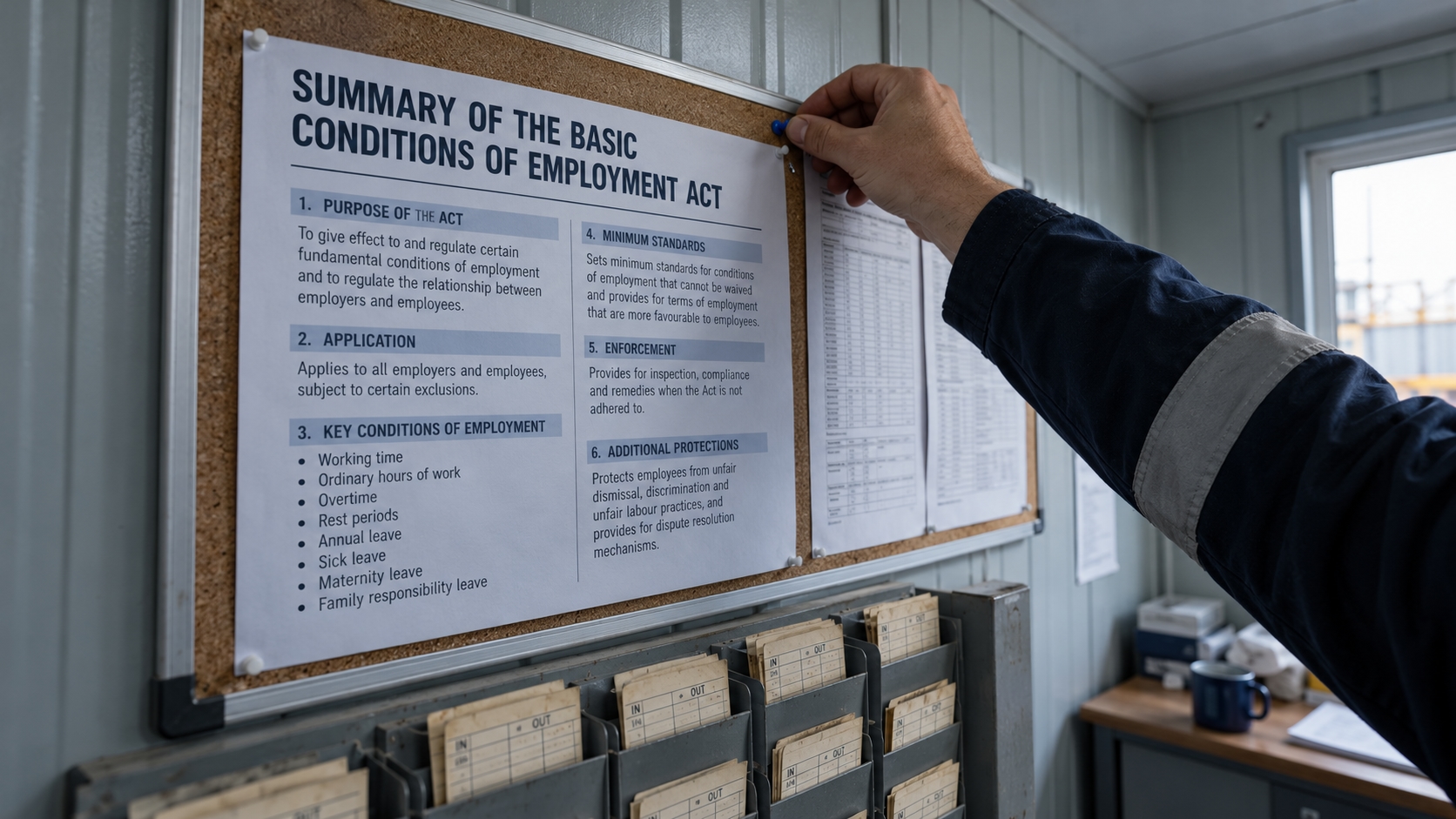
Section 30: the summary goes where employees can read it.
The BCEA on one screen: every right, with its section
The Act runs to more than 90 sections. These are the twenty an employer uses every month.
| Topic | The minimum | Section |
|---|---|---|
| Ordinary hours | 45 a week; 9 a day on a 5-day week, 8 a day on a longer one | s9 |
| Overtime | By agreement; 3 hours a day, 10 a week; at least 1.5× | s10 |
| Meal interval | 1 hour after 5 hours of continuous work (30 minutes by agreement) | s14 |
| Rest periods | 12 hours between shifts; 36 hours in a row each week | s15 |
| Sunday work | Double, or 1.5× if the employee ordinarily works Sundays | s16 |
| Night work | After 18:00 and before 06:00: allowance or shorter hours, transport | s17 |
| Public holidays | Paid; double if worked on an ordinary working day | s18 |
| Annual leave | 21 consecutive days a cycle (15 working days on a 5-day week) | s20 |
| Sick leave | Six weeks’ working days per 36-month cycle (30 on a 5-day week) | s22 |
| Sick note | After 2 consecutive days, or the 3rd absence in 8 weeks | s23 |
| Maternity and parental leave | Four months’ maternity leave; parental leave read with Van Wyk (2025) | s25 to s25C |
| Family responsibility leave | 3 days a cycle, for a sick child or a death | s27 |
| Written particulars | Every employee, on the first day | s29 |
| Display of rights | A summary of the Act on the wall | s30 |
| Payslip | Every pay day, in writing | s33 |
| Deductions | Only by law, court order or written consent | s34 |
| Notice | 1, 2 or 4 weeks by length of service | s37 |
| Severance on retrenchment | At least 1 week’s pay per completed year | s41 |
| Certificate of service | On every termination | s42 |
| Child labour | No one under 15 may be employed | s43 |
The leave rows are worked through in the BCEA leave guide, overtime and Sunday pay in the overtime guide, and notice in the notice period guide.
The BCEA poster: the section 30 display duty
Section 30 requires every employer to display, at the workplace where employees can read it, a statement of their rights under the Act in the prescribed form. It must be in the official languages spoken at the workplace.
The two compulsory summaries
BCEA s30 statement of rights + Employment Equity Act s25 notice → both on a wall employees pass every day
The prescribed summary is published by the Department of Employment and Labour; print it from labour.gov.za or buy the laminated version from a poster supplier. A staff room or clocking point works; a manager’s office does not, because employees must be able to read it. For remote staff, add it to the onboarding pack and the intranet too.
Who the BCEA covers, and who it leaves out
The Act covers every employer and employee except members of the National Defence Force, the State Security Agency and the South African Secret Service, and unpaid volunteers working for a charitable organisation (section 3). Several groups are covered with adjustments:
- Above the earnings threshold (R269,600.90 a year since 1 May 2026): the working-time sections, overtime included, do not apply.
- Domestic workers: the BCEA plus Sectoral Determination 7, which is more generous on some points, such as five days of family responsibility leave.
- Sectors with a bargaining council: a council agreement may vary some of the Act’s terms for its sector, within the limits section 49 allows.
The BCEA sets minimum conditions. Fairness of a dismissal, unfair labour practices and the CCMA belong to a different Act, the Labour Relations Act. Most disputes involve both: an unfair dismissal claim under the LRA often comes with a claim for notice pay and leave pay under the BCEA.
Four BCEA cases, answered from the section
The questions a manager checks against the Act in a normal week.
Can I roster a 50-hour week?
Ordinary hours are capped at 45 a week (section 9). The five hours over are overtime: by agreement, at 1.5 times, within the 10-hour weekly limit (section 10).
A shift ends at 22:00 and the next starts at 07:00
Nine hours between shifts. Section 15 requires twelve (reducible to ten by written agreement where the meal interval is longer). Move one shift.
An employee on R25,000 a month asks for overtime pay
Above the earnings threshold (R22,466.74 a month from 1 May 2026), so section 10 does not apply. The contract decides.
We have six staff. Must the summary be on the wall?
Yes. Section 30 applies from five employees (section 28(1) exempts fewer than five). Print the Department’s prescribed summary and put it where staff pass.
What a labour inspector checks first
The posters
The BCEA and EEA summaries on display (s30, EEA s25).
Written particulars
A contract or s29 statement for every employee. The contract template carries them.
Time and pay records
Hours, overtime and pay, kept for three years (s31).
Payslips
Every pay day, with the details section 33 requires.
Leave records
Balances that can be shown per employee. The leave tracker is built for it.
The records an inspector asks for
The Act fits on one page. The proof does not: contracts, time records, payslips and leave balances for every employee, kept for years. Synthro keeps them on each employee’s record, and NALA answers BCEA questions with the section number, so a manager can check a rule before acting on it.
Frequently Asked Questions
Where can I download the Basic Conditions of Employment Act PDF?
The official text is published by the government at gov.za and by the Department of Employment and Labour at labour.gov.za. Search for “Basic Conditions of Employment Act 75 of 1997”. Check that the copy includes the amendments up to the Labour Laws Amendment Act of 2018, which added parental leave.
What is the latest version of the BCEA?
The Basic Conditions of Employment Act 75 of 1997 as amended. The main amendments are the Basic Conditions of Employment Amendment Act of 2013, the 2018 amendment that came with the National Minimum Wage Act, and the Labour Laws Amendment Act of 2018 on parental, adoption and commissioning parental leave. Draft Bills published in February 2026 are proposals and not yet law.
Is it compulsory to display the BCEA poster in the workplace?
Yes. Section 30 of the BCEA requires every employer to display, where employees can read it, a statement of employees’ rights under the Act in the prescribed form, in the official languages spoken at the workplace. The Employment Equity Act (section 25) requires a separate notice too.
Which labour law posters must be displayed in South Africa?
At minimum the BCEA summary (BCEA section 30) and the Employment Equity Act summary (EEA section 25). Designated employers also have reporting duties under the EEA. A bargaining council agreement that binds the business may add its own display requirement.
Who does the BCEA not apply to?
Members of the National Defence Force, the State Security Agency and the South African Secret Service, and unpaid volunteers working for a charity. Parts of the Act, mainly working time and overtime, also exclude senior managers, travelling sales staff who set their own hours, and employees earning above the earnings threshold (R269,600.90 a year from 1 May 2026).
What happens if an employer does not comply with the BCEA?
A labour inspector may visit, ask for records and issue a compliance order (BCEA sections 64 to 69). An order that is ignored can be made an order of the Labour Court. Employees can also claim amounts owed under the Act.
What is the difference between the BCEA and the LRA?
The BCEA sets minimum terms of employment: hours, leave, pay records, notice and severance. The Labour Relations Act governs relationships and disputes: fair dismissal, unfair labour practices, unions, strikes and the CCMA. A contract can give more than the BCEA, never less.