What a South African payslip must show: the nine section 33 fields
Section 33 of the BCEA lists what every employee must be given in writing on every pay day. The template on this page carries all of it, in the order the Act lists it, as an Excel sheet that totals itself and a Word version for a letterhead.
| Field | Section |
|---|---|
| Employer’s name and address | s33(1)(a) |
| Employee’s name and occupation | s33(1)(b) |
| The period for which payment is made | s33(1)(c) |
| Remuneration in money | s33(1)(d) |
| The amount and purpose of every deduction | s33(1)(e) |
| The actual amount paid | s33(1)(f) |
| Ordinary pay rate and overtime rate (where relevant) | s33(1)(g), (h) |
| Ordinary and overtime hours worked (where relevant) | s33(1)(i) |
| Sunday and public holiday hours (where relevant) | s33(1)(j) |
BCEA s33(2)
in writing · on every pay day · at the workplace, in working hours or within 15 minutes of the start or end of work
The question a payslip answers later
Nobody reads a payslip until pay is disputed. Then both sides read it closely. Could you produce last March’s payslip for one employee, showing the hours, the rate and the reason for every deduction?
The payslip template: Excel that totals itself, Word for the letterhead
Free Excel payslip with gross, deductions and net calculating, every section 33 field laid out, and the rates-and-hours block for overtime months. The Word and PDF versions carry the same fields for a printed slip.
Page 1 of 1
- Excel
- Word
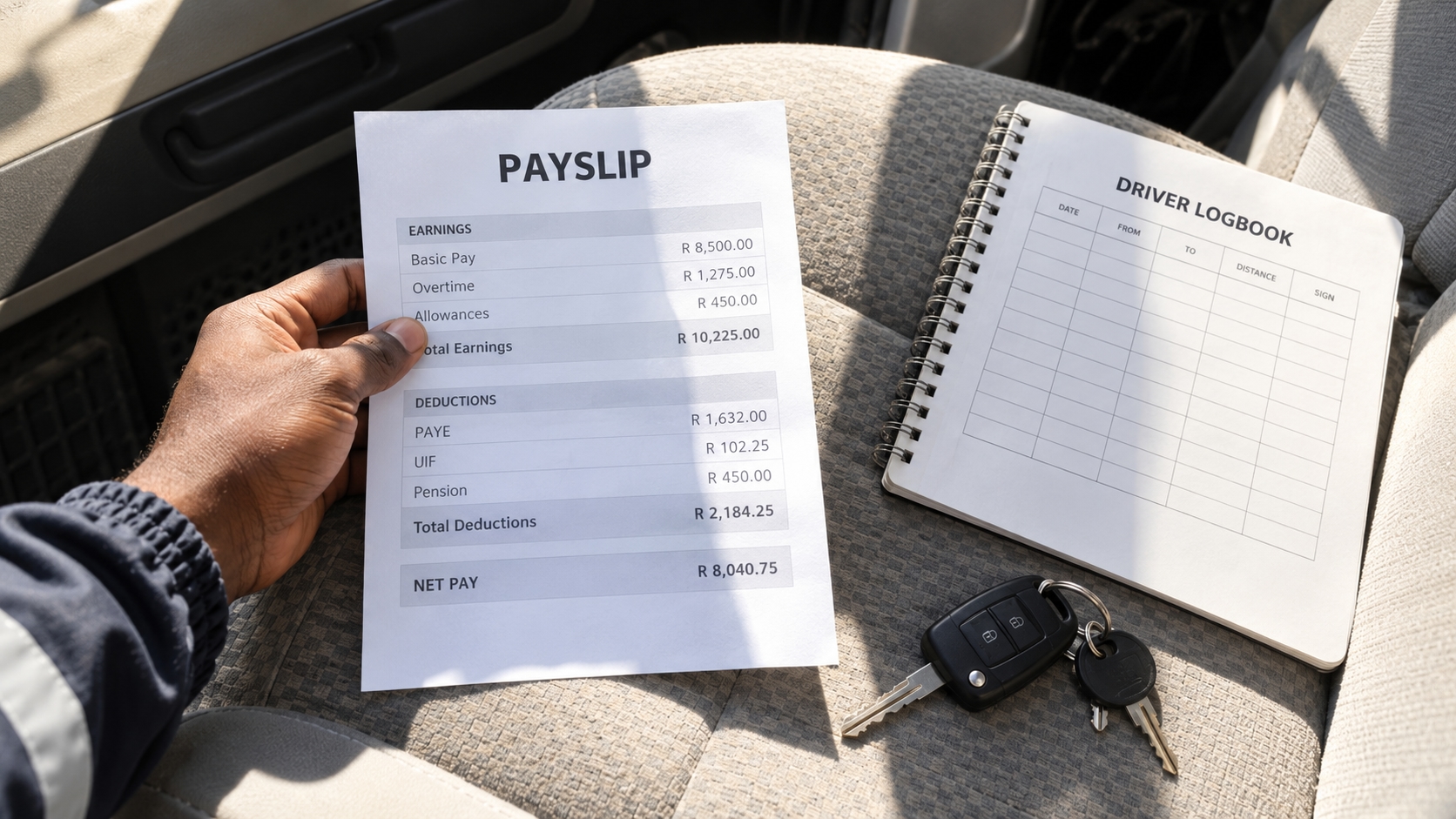
Nine fields, every pay day. The net figure alone is not a payslip.
Who must give a payslip, and who is exempt
Section 33 binds every employer with five or more employees. Section 28(1) exempts employers with fewer than five from sections 29(1)(n) to (p), 30, 31 and 33, which is where the “five employees” rule people half-remember comes from. Domestic workers are covered by Sectoral Determination 7, which has its own written pay statement requirement.
The exemption is a floor, not advice. A three-person business that pays without a payslip has no record when an employee says they were short-paid, and a payslip is the first thing the CCMA asks both sides for. The domestic worker contract page covers the household version.
Deductions: every one needs an amount, a purpose and a legal basis
Two sections work together here. Section 33(1)(e) says every deduction must appear with its amount and purpose. Section 34 says a deduction is lawful only if it is required by law or a court order (PAYE, UIF, a garnishee), allowed by a collective agreement, or agreed in writing by the employee for a specific debt. A deduction for loss or damage needs more: a fair procedure, fault, the actual loss, and a cap of one quarter of the pay.
- Always lawful: PAYE, UIF (1%), a court or maintenance order, SDL is the employer’s cost and never appears as a deduction.
- Lawful with written consent: pension, medical aid, a staff loan repayment, union dues.
- Usually unlawful: “breakages”, till shortages and uniforms deducted by default. The restaurant labour law guide works through them.
A worked payslip: R15,000 basic with eight overtime hours
On a 45-hour week the hourly rate is R15,000 × 12 ÷ 52 ÷ 45 = R76.92, so eight overtime hours at 1.5 times are R923.08. Gross: R15,923.08. UIF at 1% is R159.23. PAYE depends on the tax tables and any deductions; payroll software or the SARS tables give the figure. The payslip shows each line, the total deductions and the net amount paid. The overtime calculator produces the hours line for every employee.
The rates block (s33(1)(g) to (j)) is only required where overtime, Sunday or public holiday work is paid. Leave it on anyway: a payslip that shows the hourly rate and the hours is the document that ends a dispute about either.
Four payslip cases, worked with numbers
What goes on the slip in the situations people ask about.
Hourly worker: 160 ordinary hours at R35 and 10 overtime hours
Ordinary R5,600; overtime 10 × R35 × 1.5 = R525; gross R6,125. UIF 1% is R61.25. The rates block must show R35 and R52.50 and the 160 and 10 hours (section 33(1)(g) to (i)).
R500 a month staff loan repayment
Lawful only with the employee’s written consent for that specific debt (section 34). It appears as a deduction with its purpose, and the signed consent stays on file.
R800 for a broken till drawer, no agreement
Unlawful as a default deduction. Section 34 requires a written agreement, a fair procedure that finds fault, actual loss, and a cap of one quarter of the pay. Reverse it.
Four employees, paid in cash
Section 33 does not bind an employer with fewer than five employees (section 28(1)). Issue the payslip anyway: it is the only record if pay is disputed, and it is needed for the UI-19 declaration either way.
Keep a copy, give it on time
- Three years for the BCEA record of pay and hours (s31); five years for SARS. Keep five.
- On pay day, during working hours or within 15 minutes of the start or end of work (s33(2), (3)). An emailed PDF counts as writing.
- Prescribed form: the regulations name form BCEA 4, or any written document with the same information. The template is that document.
- POPIA: a payslip is personal information. Send it to the employee, not to a shared inbox or a WhatsApp group.
Five payslip mistakes that cost employers at the CCMA
A net figure and nothing else
Section 33 wants the period, the gross, every deduction with its purpose, and the net. One number is not a payslip.
Deductions with no consent on file
Section 34: without written consent for a specific debt, the deduction is unlawful however reasonable it was.
No hours or rates when overtime was paid
Section 33(1)(g) to (j) apply the moment premium pay is on the slip.
Payslips only on request
Every pay day, to every employee, is the rule (s33(2)).
Nothing kept
Three years under the BCEA, five for SARS. A missing payslip is read against the employer.
One payslip is a template. Forty a month is a system.
A spreadsheet payslip is right when the person filling it in had the hours, the rate and the deduction consents in front of them. Synthro records hours and leave on each employee and passes them to payroll through the SimplePay integration, so every payslip is built from the same record that would be produced at the CCMA.
Frequently Asked Questions
What must a payslip contain in South Africa?
Under section 33(1) of the BCEA: the employer’s name and address; the employee’s name and occupation; the period for which payment is made; the remuneration in money; the amount and purpose of every deduction; the actual amount paid; and, where relevant, the ordinary and overtime rates, the ordinary and overtime hours worked, and the Sunday and public holiday hours.
Is it a legal requirement to give a payslip in South Africa?
Yes, for employers with five or more employees. Section 33 of the BCEA requires written pay information on every pay day. Section 28(1) exempts employers with fewer than five employees from section 33, and domestic workers are covered by Sectoral Determination 7 instead. Giving a payslip anyway is the record that settles most pay disputes.
When must a payslip be given?
On every pay day, at the workplace or a place the employee agrees to, during working hours or within 15 minutes of the start or end of work (BCEA section 33(2) and (3)). Email counts as “in writing” if the employee can open it.
How long must payslips be kept?
Three years from the date of the last entry, under section 31 of the BCEA, which covers records of pay and hours. SARS requires payroll records for five years, so most employers keep payslips for five.
Can an employer deduct money without it showing on the payslip?
No. Every deduction must appear with its amount and purpose (section 33(1)(e)), and a deduction is only lawful by law, court order, collective agreement or the employee’s written consent for a specific debt (section 34). An unexplained deduction is both a section 33 and a section 34 breach.
Is there an official payslip form?
The BCEA regulations prescribe form BCEA 4, and say the information may be given on that form or in any written form that contains the same information. This template carries every BCEA 4 field.
Does a payslip have to show leave balances?
Not under section 33. Many employers add the annual and sick leave balances because it stops the question being asked, and because section 31 requires the leave record to be kept anyway. The template has an optional line for it.
What is the difference between gross pay, remuneration and net pay on a payslip?
Gross pay is everything earned before deductions. Remuneration in money is the BCEA’s term for the same thing in cash, excluding payments in kind. Net pay is the actual amount paid after deductions, the figure section 33(1)(f) requires.