Overtime in South Africa: 1.5 times, up to 10 hours a week
Under section 10 of the BCEA, overtime is paid at least one and a half times the ordinary wage, may only be worked by agreement, and is capped at three hours a day and ten hours a week. Overtime is anything worked beyond ordinary hours, which section 9 caps at 45 a week: nine hours a day on a five-day week, or eight hours a day on a longer one.
BCEA s10 and s35
monthly salary ÷ 4.333 ÷ ordinary weekly hours = hourly rate · hourly rate × 1.5 × overtime hours = overtime pay
Where overtime claims are won
Overtime disputes are rarely about the rate. They are about the hours: who worked them, who agreed to them, and whether anyone wrote them down. Could you produce last month’s overtime hours for one employee, with who approved them?
The overtime agreement belongs in the contract
Free Word and PDF employment contract with the BCEA section 29 particulars and an overtime clause built on section 10: agreement, the daily and weekly limits, the rate and who authorises the hours.
Page 1 of 4
- Word
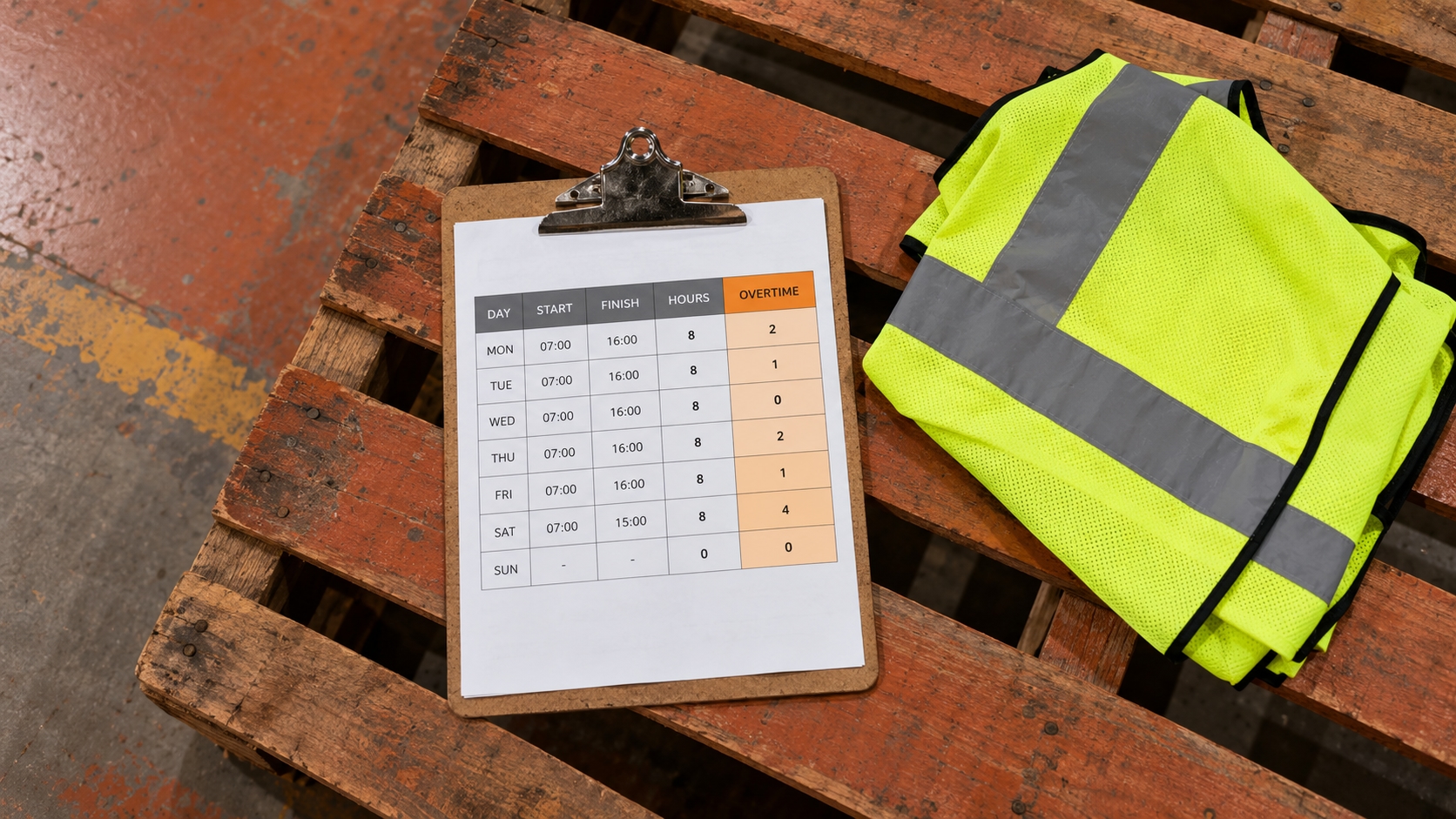
Overtime is decided on the record of hours, not the rate.
Weekday, Sunday and public holiday rates
| When the work happens | Minimum rate | Section |
|---|---|---|
| Overtime, Monday to Saturday | 1.5 × hourly wage | BCEA s10(2) |
| Sunday, for someone who does not ordinarily work Sundays | 2 × wage | BCEA s16(1) |
| Sunday, for someone who ordinarily works Sundays | 1.5 × wage | BCEA s16(1) |
| Public holiday that is an ordinary working day | 2 × daily wage, or wage plus earnings | BCEA s18(2) |
| Night work, after 18:00 and before 06:00 | Allowance or shorter hours, by agreement | BCEA s17 |
Worked example: a month of overtime
R12,000 a month, 45-hour week, 6 weekday overtime hours and 4 Sunday hours
| Weekly wage | R12,000 ÷ 4.333 (s35) | R2,769.44 |
| Hourly rate | R2,769.44 ÷ 45 | R61.54 |
| Weekday overtime | 6 × R61.54 × 1.5 | R553.86 |
| Sunday (not a usual day) | 4 × R61.54 × 2 | R492.32 |
| Extra pay this month | R553.86 + R492.32 | R1,046.18 |
Use the ordinary hours in the employee’s own contract. The same R12,000 on a 40-hour week is R69.23 an hour, and every overtime hour is worth R103.85. The daily rate calculator converts any salary, and the working days guide explains the 4.333 and 21.67 divisors.
Work out the overtime rate for your team
Enter each employee’s salary and ordinary hours. The calculator gives the hourly, overtime, Sunday and public holiday rates using the section 35 divisors, and emails the whole rate card as an Excel file.
Daily & Hourly Rate Calculator
Turn a monthly salary into the daily, hourly, overtime, Sunday and public-holiday rates South African payroll actually runs on - the “divide by 21.67” calculation, done properly, with the BCEA sections shown.
National minimum wage R30.23/hour from 1 March 2026. Domestic and farm workers are on the full rate; EPWP workers are on the separate lower rate. Figures are pre-tax.
The R269,600.90 earnings threshold
Employees who earn more than the BCEA earnings threshold are outside the working-time sections, overtime pay included. The threshold is R269,600.90 a year from 1 May 2026 (Government Notice 7384, Government Gazette 54544 of 17 April 2026), up from R261,748.45. That is about R22,466 a month.
Earnings for the test are regular pay before deductions. They exclude overtime itself, and employer contributions, travel and subsistence allowances, and achievement awards. The practical consequence: someone on R22,000 a month who was treated as “above the threshold” last year is now below it, and their overtime has been payable since 1 May.
- Check every salary between R21,812 and R22,466 a month: that band crossed back under.
- Above the threshold, overtime is whatever the contract says, and only the contract.
Five overtime cases, worked with numbers
Every case is different, so here are the ones people actually ask about, on a salary of R15,000 a month, a 45-hour week and an hourly rate of R76.92 (R15,000 × 12 ÷ 52 ÷ 45).
Worked 5 extra hours on a Tuesday night, 18:00 to 23:00
5 × R76.92 × 1.5 = R576.92 overtime. Because the hours are after 18:00, section 17 also requires a night allowance or shorter hours by agreement, and transport home. The Act sets no percentage for the allowance; your contract or bargaining council does.
Worked 5 hours on a Saturday, Monday to Friday employee
Saturday is not a Sunday. The hours are overtime at 1.5 times: 5 × R76.92 × 1.5 = R576.92, and they count towards the 10-hour weekly limit.
Worked 5 hours on a Sunday, does not usually work Sundays
Double: 5 × R76.92 × 2 = R769.23. Section 16(2) adds a floor: if the Sunday pay works out below the ordinary daily wage (R692.31 here), pay the daily wage. R769.23 is above it, so R769.23.
Worked 5 hours on Freedom Day, an ordinary working day
Section 18(2): at least double the ordinary daily wage, or the daily wage plus the hours worked, whichever is greater. Double the day is R1,384.62; the day plus 5 hours is R692.31 + R384.62 = R1,076.92. Pay R1,384.62.
Same hours, but the employee earns R24,000 a month
Above the earnings threshold (R22,466.74 a month from 1 May 2026), so sections 10, 16 and 18(3) do not apply. Overtime is whatever the contract says. If it says nothing, nothing is owed, which is why the contract should say something.
What the overtime agreement should say
Overtime is lawful only by agreement (section 10(1)), so the agreement is the first document a commissioner asks for in an overtime dispute. A clause in the contract works, with one catch: an agreement made when the employee starts, or in their first three months, lapses after one year (section 10(1A)), so renew it in writing at the first anniversary.
- That overtime may be required, and how much notice the employee gets of it
- The limits: three hours a day and ten a week
- The rate, at least 1.5 times, or paid time off by agreement under section 10(3)
- Who may authorise overtime, and how hours are recorded and approved
The last point does the most work. Hours worked without authorisation are still hours worked: if a manager knew about them and let them happen, they are usually payable. The fix is a record that shows approval before the shift, not an argument after it.
Five overtime mistakes that end up at the CCMA
Overtime with no agreement
Section 10(1) requires one. Put it in the contract, and renew it if it was signed in the first three months.
Using 195 hours for everyone
A 40-hour contract divides by 173.33. The wrong divisor underpays every hour.
Paying Sunday at 1.5 for an occasional Sunday
Double, unless the employee ordinarily works Sundays (section 16).
Last year’s threshold
R269,600.90 since 1 May 2026. Staff just under it are owed overtime.
No record of hours
A claim for unpaid overtime is decided on records. Without timesheets, the employee’s version usually stands.
The hours are the evidence
An overtime claim is decided on the record of hours. Synthro records clock-in and clock-out on the employee’s phone, flags hours past the daily and weekly limits, and holds the manager’s approval against each overtime shift, so the payroll figure and the proof are the same record.
Frequently Asked Questions
What is the overtime rate in South Africa?
At least one and a half times the employee’s ordinary hourly wage, under section 10(2) of the BCEA. Sunday work is double (or one and a half times for someone who ordinarily works Sundays, section 16), and work on a public holiday that is an ordinary working day is double (section 18).
How many hours of overtime are allowed per week in South Africa?
Ten hours a week and three hours a day, under section 10(1) of the BCEA, and only by agreement. A collective agreement can raise the weekly limit for a limited period. Ordinary hours are capped separately at 45 a week by section 9.
Who is not entitled to overtime pay in South Africa?
Employees earning more than the BCEA earnings threshold, which is R269,600.90 a year (about R22,466 a month) from 1 May 2026. Senior managers, sales staff who travel and set their own hours, and people working fewer than 24 hours a month are also excluded from the working-time sections.
How do you calculate overtime from a monthly salary?
Turn the salary into an hourly rate first: monthly salary ÷ 4.333 ÷ ordinary weekly hours (BCEA section 35). Then multiply by 1.5 and by the overtime hours. For R12,000 a month on a 45-hour week: R12,000 ÷ 4.333 ÷ 45 = R61.54 an hour, so an overtime hour is R92.31.
Can an employer force an employee to work overtime?
Not without agreement. Section 10(1) allows overtime only in accordance with an agreement. The agreement can be in the contract, but an agreement made in the first three months of employment lapses after a year (section 10(1A)). Refusing overtime that was never agreed is not misconduct.
Can overtime be paid as time off instead?
Yes, if the employee agrees. Section 10(3) allows an agreement to replace overtime pay, wholly or partly, with paid time off. Record the hours, the rate of time off and when it was taken, or the time off becomes impossible to prove.